Jörn Dengjel
Mass-spectrometry proteomics specialist in autophagy and protein homeostasis; co-author on the TBK1/ULK1–TFEB lysosomal stress pathway and on the spermidine lifespan and cardioprotection study.
Professor of Biochemistry and Cell Biology, Department of Biology, University of Fribourg (since 2016) · Professor of Medical Proteome Research, Department of Dermatology, University of Freiburg (2013) · junior fellow, Freiburg Institute for Advanced Studies (2009) · EMBO fellow, University of Southern Denmark (2006) · PhD, Department of Immunology, University of Tübingen (2005)
Dengjel Lab, Department of Biology, University of Fribourg (Fribourg, Canton of Fribourg, Switzerland) ↗ ORCID0000-0002-9453-4614 ↗
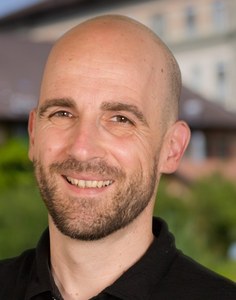 Portrait: University of Fribourg (via MENTOR doctoral network)
He is among the senior co-authors of the study showing that lysosomal stress activates TFEB through a v-ATPase–TBK1/ULK1–FNIP1 route that works independently of nutrients (ESP2026); his group runs mass-spectrometry proteomics. Earlier, from Freiburg, he co-authored the work showing that oral spermidine extends mouse lifespan and protects the heart through autophagy (EIS2016).
He studied biochemistry in Potsdam and Tübingen and did his PhD in Tübingen on MHC class II peptide presentation using mass spectrometry. After an EMBO fellowship in Odense working on proteomics and autophagy, he set up his group in Freiburg in 2009 and moved to Fribourg in 2016.
Milestones in the Atlas
A selection, not a full bibliography: only papers that meet the Atlas inclusion criteria.
| Year | Evidence | Study |
|---|---|---|
| 2016 | A | Cardioprotection and lifespan extension by the natural polyamine spermidine EIS2016 Co-author: oral spermidine extends mouse lifespan and protects the heart in an autophagy-dependent way. |
| 2026 | M | A TBK1/ULK1 signalling axis couples lysosomal stress to TFEB activation. ESP2026 Senior co-author (proteomics lab): lysosomal stress activates TFEB via v-ATPase–TBK1/ULK1 phosphorylation of FNIP1. |
Co-authors in the Atlas
People with a profile here who share at least one study with Jörn Dengjel.
- Alessandra Esposito Lysosomal signalling and TFEB regulation
- Alessia Calcagnì TIGEM researcher on the TFEB/TFE3 side of mTORC1 signalling; co-author on the lysosomal stress route to TFEB activation and on mouse models separating mTORC1 from TFEB/TFE3 in kidney cysts and tumours.
- Andrea Ballabio Discovered that the transcription factor TFEB is a master switch for building lysosomes and for autophagy. His lab was one of the groups that showed in 2012 that mTORC1 keeps TFEB out of the nucleus from the lysosome surface, and later (2020) that constitutive TFEB activation drives the kidney disease of Birt-Hogg-Dubé syndrome
- Didac Carmona-Gutierrez Studies how cell death and autophagy shape ageing at the University of Graz, and contributed to the studies showing that spermidine extends lifespan through autophagy
- Frank Madeo Established spermidine as a dietary compound that extends lifespan in yeast, worms, flies and mice, and showed that the effect depends on autophagy
- Frauke Neff First author of the study that separated what rapamycin does to lifespan from what it does to ageing itself
- Gennaro Napolitano mTORC1-TFEB lysosomal signalling
- Christoph Magnes Analytical chemist at Joanneum Research whose group contributed the mass-spectrometry measurements of polyamines in the Graz spermidine studies
- Christoph Ruckenstuhl Yeast geneticist who works out how amino-acid restriction and vacuole acidity set lifespan
- James H. Hurley Structural biologist who uses cryo-EM to show how protein machines assembled on membranes control autophagy and nutrient signalling. His lab solved structures of the Rag–Ragulator complex and of the whole mTORC1–TFEB–Rag–Ragulator assembly on the lysosome
- Jlenia Monfregola TIGEM postdoc and co-author on the cryo-EM structure of the mTORC1–TFEB–Rag–Ragulator megacomplex and on the TBK1/ULK1 lysosomal stress route to TFEB.
- Junichi Sadoshima Studies how mTOR, autophagy and mitophagy protect the heart under stress and in ageing, and contributed to the finding that spermidine protects the heart
- Luca Scorrano Mitochondrial biologist known for showing how the shape of mitochondria and their inner folds (cristae) control energy production and cell death.
- Martin Hrabě de Angelis Mouse geneticist who directs large-scale phenotyping of mouse mutants and the German Mouse Clinic, a platform that tests how genes affect health and disease.
- Roberto Zoncu Showed as a postdoc that mTORC1 senses amino acids from inside the lysosome, through the v-ATPase and Ragulator. His Berkeley lab has since mapped how the Rag GTPases and the folliculin complex switch mTORC1 on, and how lysosomal cholesterol feeds into the same system
- Sabrina Büttner Studies how organelles communicate inside cells and how that communication breaks down with age, and contributed to the Graz studies showing that spermidine extends lifespan by inducing autophagy
- Sabrina Schroeder Researcher in Frank Madeo's group at Graz who has contributed to the spermidine studies from the first yeast longevity experiments to work in mice
- Tobias Eisenberg Showed as first author that the dietary polyamine spermidine extends lifespan by inducing autophagy, and later that it protects the heart in an autophagy-dependent way
Every researcher with a profile →
Thank you. Your answer was counted anonymously.
Thank you. That helps us know which pages have been read by someone who knows the work.
Thank you. We will check it and correct the page.