Gennaro Napolitano
mTORC1-TFEB lysosomal signalling
Telethon Institute of Genetics and Medicine (TIGEM), Naples · Medical Genetics Unit, Federico II University, Naples
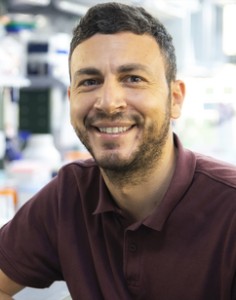 Portrait: TIGEM
Gennaro Napolitano is based at the Telethon Institute of Genetics and Medicine (TIGEM) in Naples, with the Medical Genetics Unit at Federico II University.
He is corresponding/senior author on a 2026 Nature paper describing a nutrient-independent lysosomal pathway in which TBK1/ULK1 inhibits the FLCN:FNIP complex to release TFEB from mTORC1 control — a pathway constitutively activated by ATP6V1B2 mutations in follicular lymphoma, driving TFEB-dependent tumour proliferation.
Milestones in the Atlas
A selection, not a full bibliography: only papers that meet the Atlas inclusion criteria.
| Year | Evidence | Study |
|---|---|---|
| 2020 | M | A substrate-specific mTORC1 pathway underlies Birt-Hogg-Dubé syndrome. NAP2020 A substrate-specific mTORC1-TFEB pathway (RagC/D-dependent) drives Birt-Hogg-Dube kidney disease. |
| 2023 | M | Structure of the lysosomal mTORC1-TFEB-Rag-Ragulator megacomplex CUI2023 First structural view of how mTORC1 actually reaches TFEB to phosphorylate it: two full Rag-Ragulator complexes present a single TFEB molecule to the mTOR active site, one in the normal Raptor-docking arrangement and a second, non-canonical one that grips TFEB's own first helix. Mutating that grip point drives TFEB straight into the nucleus (turning on autophagy/lysosome genes) without disturbing where mTORC1 itself sits. Explains, at the level of atoms, why TFEB phosphorylation needs the tumour suppressor FLCN and the GDP-loaded state of RagC in a way the authors report for no other mTORC1 substrate. Boundary: cryo-EM of a complex reconstituted from purified human proteins — a static structural snapshot, not a live cell or a real-time measurement. |
| 2025 | M | Structural basis for mTORC1 activation on the lysosomal membrane CUI2025 Resolves how mTORC1 flips from 'parked on the lysosome' to 'catalytically switched on'. Reconstituting the whole assembly on membranes from purified Rheb, Rag GTPases, Ragulator and mTORC1, cryo-EM shows the kinase reaches full activity only after two separate anchoring steps: Rag-Ragulator first pulls it to within about 100 angstroms of the membrane, then Rheb pulls it to within about 40 angstroms, and only when Raptor and mTOR itself also touch the membrane directly do the catalytic residues line up for full activity. Growth-factor input (via Rheb) and nutrient input (via the Rags) are shown converging on the same physical docking event rather than acting through separate switches. Boundary: reconstituted on synthetic membranes from purified components — a structural/biochemical model, not a measurement inside a living cell. |
| 2026 | M | A TBK1/ULK1 signalling axis couples lysosomal stress to TFEB activation. ESP2026 Corresponding author on the Nature paper describing the TBK1/ULK1-FLCN-TFEB lysosomal signalling axis and its hijacking by ATP6V1B2 mutations in follicular lymphoma. |
Co-authors in the Atlas
People with a profile here who share at least one study with Gennaro Napolitano.
- Andrea Ballabio 4 shared studies Discovered that the transcription factor TFEB is a master switch for building lysosomes and for autophagy. His lab was one of the groups that showed in 2012 that mTORC1 keeps TFEB out of the nucleus from the lysosome surface, and later (2020) that constitutive TFEB activation drives the kidney disease of Birt-Hogg-Dubé syndrome
- Alessandra Esposito 3 shared studies Lysosomal signalling and TFEB regulation
- James H. Hurley 3 shared studies Structural biologist who uses cryo-EM to show how protein machines assembled on membranes control autophagy and nutrient signalling. His lab solved structures of the Rag–Ragulator complex and of the whole mTORC1–TFEB–Rag–Ragulator assembly on the lysosome
- Jlenia Monfregola 2 shared studies TIGEM postdoc and co-author on the cryo-EM structure of the mTORC1–TFEB–Rag–Ragulator megacomplex and on the TBK1/ULK1 lysosomal stress route to TFEB.
- Zhicheng Cui 2 shared studies Structural biologist who solved cryo-EM structures of the mTORC1–TFEB–Rag–Ragulator megacomplex and of mTORC1 switched on by RHEB and the Rags on a lipid membrane.
- Alessia Calcagnì TIGEM researcher on the TFEB/TFE3 side of mTORC1 signalling; co-author on the lysosomal stress route to TFEB activation and on mouse models separating mTORC1 from TFEB/TFE3 in kidney cysts and tumours.
- Jörn Dengjel Mass-spectrometry proteomics specialist in autophagy and protein homeostasis; co-author on the TBK1/ULK1–TFEB lysosomal stress pathway and on the spermidine lifespan and cardioprotection study.
- Lukas A. Huber Cell biologist who studied the p14-MP1 scaffold on late endosomes, a complex later recognised as part of Ragulator (LAMTOR), the lysosomal platform that holds mTORC1 in place
- Roberto Zoncu Showed as a postdoc that mTORC1 senses amino acids from inside the lysosome, through the v-ATPase and Ragulator. His Berkeley lab has since mapped how the Rag GTPases and the folliculin complex switch mTORC1 on, and how lysosomal cholesterol feeds into the same system
Every researcher with a profile →
Thank you. Your answer was counted anonymously.
Thank you. That helps us know which pages have been read by someone who knows the work.
Thank you. We will check it and correct the page.