Lukas A. Huber
Cell biologist who studied the p14-MP1 scaffold on late endosomes, a complex later recognised as part of Ragulator (LAMTOR), the lysosomal platform that holds mTORC1 in place
Director, Institute of Cell Biology, Medical University of Innsbruck · Professor of Cell Biology, Innsbruck (since 2002) · Director, Austrian Drug Screening Institute (since 2012) · Founding Director, Biocenter Innsbruck (2005–2013) · Group Leader, IMP Vienna (1996–2002) · MD, University of Innsbruck (1989)
Huber Laboratory, Institute of Cell Biology, Medical University of Innsbruck (Innsbruck, Tyrol, Austria) ↗ ORCID0000-0003-1116-2120 ↗
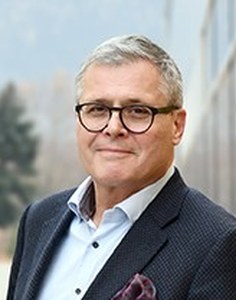 Portrait: Medical University of Innsbruck
Lukas Huber trained as a medical doctor in Innsbruck and did postdoctoral work at the European Molecular Biology Laboratory in Heidelberg before running his own group at the Institute of Molecular Pathology in Vienna. In the early 2000s his team described a small protein pair, p14 and MP1, that sits on late endosomes and helps a signalling kinase cascade (MAPK) work at the right place in the cell. At the time it looked like a niche trafficking story.
It turned out to be the seed of a much larger discovery. p14 and MP1 are two of the five subunits of Ragulator, the complex that Sabatini's group later showed anchors the Rag GTPases and therefore mTORC1 on the lysosome. Huber's laboratory in Innsbruck has continued on this LAMTOR/Ragulator complex, and links it to nutrient sensing, immune disease and Birt-Hogg-Dubé syndrome.
The study in the Atlas, from 2023, is a cryo-electron microscopy structure led by James Hurley's group at Berkeley with Andrea Ballabio's group in Naples and Huber's in Innsbruck. It shows two Rag-Ragulator complexes together presenting the transcription factor TFEB to mTORC1 for phosphorylation, and gives a physical explanation for why TFEB depends so strongly on the FLCN protein.
Milestones in the Atlas
A selection, not a full bibliography: only papers that meet the Atlas inclusion criteria.
| Year | Evidence | Study |
|---|---|---|
| 2023 | M | Structure of the lysosomal mTORC1-TFEB-Rag-Ragulator megacomplex CUI2023 Co-author of the Nature cryo-EM structure of the mTORC1-TFEB-Rag-Ragulator megacomplex; his Innsbruck laboratory works on the LAMTOR/Ragulator complex at the core of the structure. |
Co-authors in the Atlas
People with a profile here who share at least one study with Lukas A. Huber.
- Alessandra Esposito Lysosomal signalling and TFEB regulation
- Andrea Ballabio Discovered that the transcription factor TFEB is a master switch for building lysosomes and for autophagy. His lab was one of the groups that showed in 2012 that mTORC1 keeps TFEB out of the nucleus from the lysosome surface, and later (2020) that constitutive TFEB activation drives the kidney disease of Birt-Hogg-Dubé syndrome
- Gennaro Napolitano mTORC1-TFEB lysosomal signalling
- James H. Hurley Structural biologist who uses cryo-EM to show how protein machines assembled on membranes control autophagy and nutrient signalling. His lab solved structures of the Rag–Ragulator complex and of the whole mTORC1–TFEB–Rag–Ragulator assembly on the lysosome
- Jlenia Monfregola TIGEM postdoc and co-author on the cryo-EM structure of the mTORC1–TFEB–Rag–Ragulator megacomplex and on the TBK1/ULK1 lysosomal stress route to TFEB.
- Zhicheng Cui Structural biologist who solved cryo-EM structures of the mTORC1–TFEB–Rag–Ragulator megacomplex and of mTORC1 switched on by RHEB and the Rags on a lipid membrane.
Every researcher with a profile →
Thank you. Your answer was counted anonymously.
Thank you. That helps us know which pages have been read by someone who knows the work.
Thank you. We will check it and correct the page.