mTOR Academy
Four ways into mTOR biology.
Read the mechanism, practise it until you can predict it, follow one question all the way through the map, or run an investigation of your own. All four are built on the same evidence-graded studies as the rest of the Atlas.
Your first hour
Think you can reason like an mTOR researcher? Ten hard questions, five minutes, placed at the rank your answers earn. Take the Qualifying Exam →
Four ways in
Learn
The mental model most mTOR papers assume you already have — one mechanism at a time, with the evidence attached.
15–30 min each · start anywhereRead lesson 01 →What you need first →Practice Arena
Predict a perturbation, rebuild a route, name what a result does not show. Points reward calibration, not speed.
442 questions · 3 min a roundPlay →Research Challenges
Take a question the field has not closed, commit to a hypothesis, spend a limited research budget, and compare your reasoning with what was published.
~30 min · needs the basics firstInvestigate →Guided Routes
Follow one question all the way through the pathway map, step by step, in the interactive Atlas.
No score · just readingExplore →- ○01What is mTOR?
- ○02mTORC1 vs mTORC2
- ○03Rheb — The Critical Regulator
- ○04The TSC Complex — Where the Inputs Meet
- ○05The Lysosome as a Signalling Platform
- ○06Nutrient Sensing
- ○07Growth Factor Signalling
- ○08Feedback Regulation
- ○09mTOR and Autophagy
- ○10How to Read an mTOR Paper
Explore the Atlas
Every lesson, game and challenge points back into the database it was written from.
For beginners and teachers
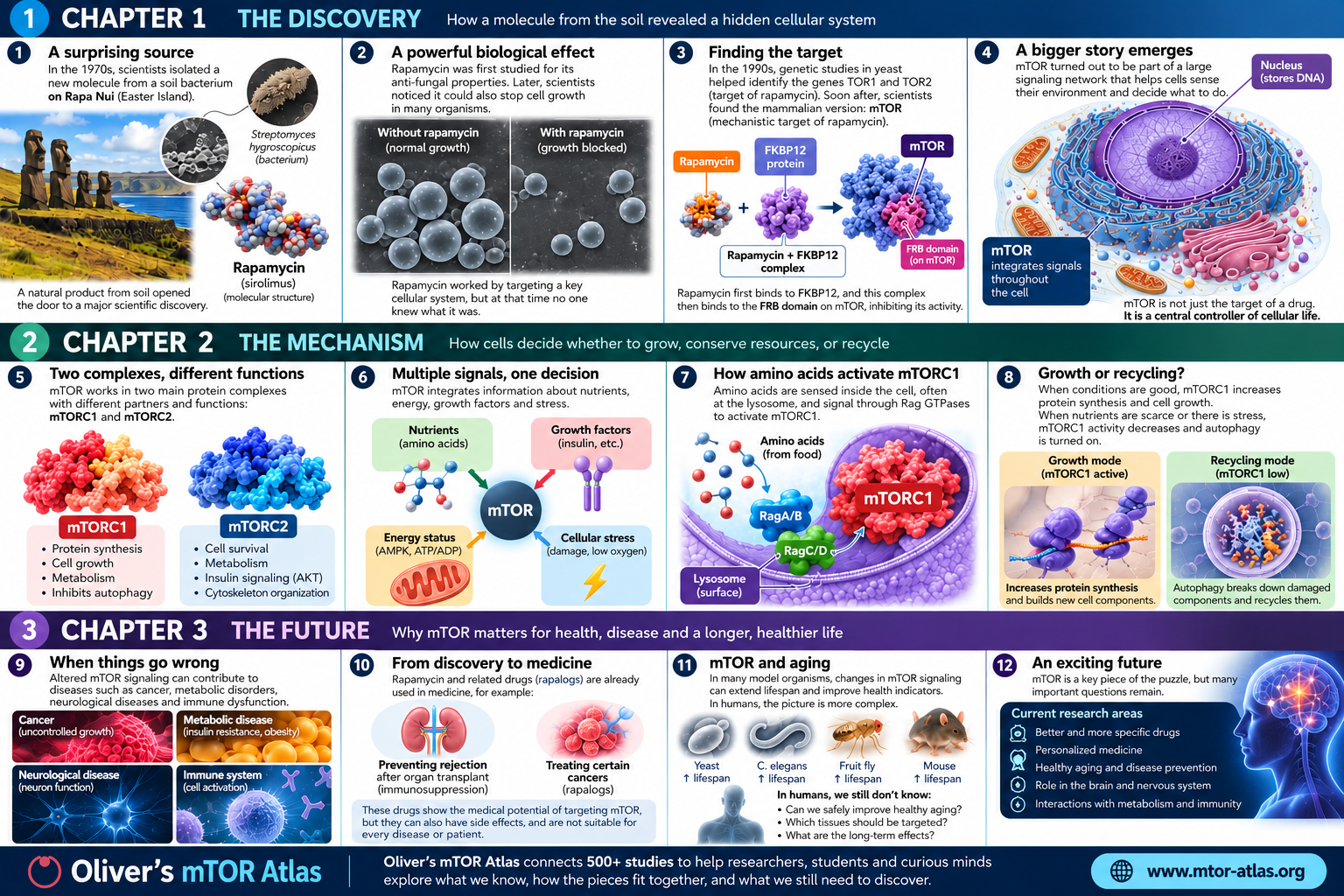
The mTOR story on one page
A twelve-panel poster for readers meeting mTOR for the first time: from a soil bacterium on Easter Island to the cell’s growth-or-recycle decision and what it means for medicine and ageing. It simplifies on purpose; the lessons carry the evidence.
Open full sizePDF for the classroom (A3 landscape, 2.8 MB)
Read the poster as text
Chapter 1 · The discovery
- In the 1970s, scientists isolated a new molecule from a soil bacterium collected on Rapa Nui (Easter Island). They named it rapamycin.
- Rapamycin was first studied as an antifungal drug. Researchers then noticed that it stops cell growth in many organisms.
- In the 1990s, genetic studies in yeast found the genes TOR1 and TOR2 (target of rapamycin). Soon after, the mammalian version was found: mTOR. Rapamycin first binds a small protein called FKBP12, and this pair then binds the FRB domain of mTOR and blocks its activity.
- mTOR turned out to be part of a large signalling network that helps cells sense their environment and decide what to do. It is not just the target of a drug; it is a central controller of how cells live.
Chapter 2 · The mechanism
- mTOR works in two protein complexes. mTORC1 drives protein synthesis and cell growth and holds back autophagy. mTORC2 supports cell survival, metabolism, insulin signalling through AKT and the cell's skeleton.
- mTOR combines four kinds of information: nutrients such as amino acids, growth factors such as insulin, the cell's energy status (AMPK, the ATP to ADP ratio) and stress such as damage or low oxygen.
- Amino acids are sensed at the surface of the lysosome, the cell's recycling centre. They signal through Rag GTPases (RagA/B and RagC/D), which bring mTORC1 to the lysosome so it can be switched on.
- When conditions are good, active mTORC1 builds proteins and new cell parts. When nutrients are scarce or the cell is stressed, mTORC1 activity drops and autophagy starts: the cell breaks down damaged parts and reuses the material.
Chapter 3 · The future
- Altered mTOR signalling can contribute to cancer, metabolic disease such as insulin resistance, neurological disease and problems with the immune system.
- Rapamycin and related drugs (rapalogs) are already used in medicine, for example to prevent rejection after organ transplants and to treat certain cancers. They also have side effects and are not suitable for every disease or patient.
- In yeast, worms, flies and mice, reducing mTOR signalling can extend lifespan. In humans we still do not know whether it can safely improve healthy ageing, which tissues should be targeted, or what the long-term effects are.
- Open research areas include more specific drugs, personalised medicine, healthy ageing, mTOR in the brain, and how mTOR links metabolism and immunity.
Beyond the Atlas
Free courses and lectures elsewhere, from MIT, Coursera, iBiology and others, each marked with its level, certificate and how much mTOR it covers.
Thank you. Your answer was counted anonymously.