Gianluca Figlia
Cell biologist who studied how mTORC1 senses nutrients in Aurelio Teleman's group at the German Cancer Research Center, including the finding that glutamine is sensed through the kinase GCN2, and who now works at the Institute of Neuropathology in Aachen
Institute of Neuropathology, RWTH Aachen University Hospital (2025–) · Division of Signal Transduction in Cancer and Metabolism (Aurelio Teleman), German Cancer Research Center (DKFZ) and Heidelberg University (papers 2020–2025) · Institute of Molecular Health Sciences (Ueli Suter), ETH Zurich (papers 2014–2018)
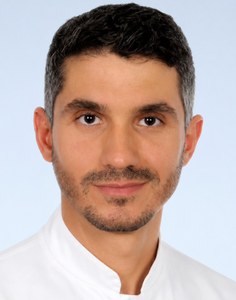 Portrait: LinkedIn
Gianluca Figlia appears on two Atlas studies about brakes on mTORC1, the growth-control complex. The 2021 Cell paper (PRE2021) found that G3BP1 and G3BP2, proteins best known from stress granules, also sit on the surface of the lysosome, the cell's recycling compartment where mTORC1 is switched on. There they hold the TSC complex, the main off-switch for mTORC1, in place. Without them mTORC1 reacts too strongly to amino acids and insulin. The 2023 Nature Cell Biology paper (NIC2023) showed that malonyl-CoA, a building block made on the way to new fatty acids, fits into the same pocket of mTOR that normally holds ATP and so blocks it. When a cell cannot make fat fast enough, malonyl-CoA rises and slows mTORC1 down. Both results come mainly from cells; the first adds zebrafish experiments, and the second shows the malonyl-CoA effect is conserved across species.
Figlia's path ran through two labs that both linked mTOR to lipids. At ETH Zurich, in Ueli Suter's group, Figlia was second author of a 2014 Cell Reports paper showing in mice that mTORC1 in Schwann cells, the cells that wrap nerves in insulating myelin, drives myelin growth by switching on fat-making genes through SREBP. At the German Cancer Research Center (DKFZ) in Heidelberg, in Aurelio Teleman's group, Figlia was first author of a 2020 review on how metabolites control signalling by attaching chemically to proteins, and first author of a 2025 EMBO Journal paper showing that cells sense glutamine for mTORC1 entirely through the kinase GCN2, triggered by the loss of asparagine.
The 2025 paper and a 2026 commentary on TDP-43 disease list Figlia at the Institute of Neuropathology, RWTH Aachen University Hospital.
Milestones in the Atlas
A selection, not a full bibliography: only papers that meet the Atlas inclusion criteria.
| Year | Evidence | Study |
|---|---|---|
| 2021 | M | G3BPs tether the TSC complex to lysosomes and suppress mTORC1 signaling PRE2021 Co-author: contributed to the study showing that G3BP1 and G3BP2 tether the TSC complex to lysosomes and so hold mTORC1 in check. |
| 2023 | M | Malonyl-CoA is a conserved endogenous ATP-competitive mTORC1 inhibitor NIC2023 Co-author: contributed from the DKFZ to the study showing that malonyl-CoA binds the mTOR catalytic pocket and inhibits mTORC1. |
Co-authors in the Atlas 17
People with a profile here who share at least one study with Gianluca Figlia.
ShowHide
- Aurelio A. Teleman 2 shared studies Uses fruit-fly genetics and human cells to study how growth signalling through TOR controls cell and body size. His lab showed that starvation and other stresses move TSC2 to the lysosome to switch mTORC1 off
- Constantinos Demetriades 2 shared studies Showed as a postdoc in Aurelio Teleman's lab that starvation and other stresses pull TSC2 to the lysosome to switch mTORC1 off. His group, at the Max Planck Institute for Biology of Ageing in Cologne from 2017 and at ERIBA in Groningen since 2025, studies how cells sense nutrients and stress through mTORC1 and how this changes with age
- Laura Brohée 2 shared studies Cell biologist who studied how lipid metabolism and the lysosome feed into mTORC1, first at the University of Liège and then at the Max Planck Institute for Biology of Ageing in Cologne
- Alexander M Heberle Cell biologist and Junior Group Leader at the University of Innsbruck who studies how mTOR balances growth signalling and metabolism when cells are under stress, trained in Kathrin Thedieck's systems-biology group
- Bernadette Carroll First author of the study showing why mTORC1 stays switched on in senescent cells, and co-author on G3BP–TSC and senescence-mitophagy work; her own lab studies how nutrient sensing breaks down in ageing cells.
- Claudio De Virgilio Yeast geneticist whose lab found the EGO/Rag GTPase complex that activates TORC1 and showed that the SEACIT complex (Iml1–Npr2–Npr3) switches TORC1 off by acting as a GAP for the Rag GTPase Gtr1.
- Julian Nüchel Co-author on two Demetriades-lab mTORC1 papers from Cologne: the spatial split of mTORC1 signalling by amino acid source and malonyl-CoA as a direct mTORC1 inhibitor.
- Julian R. Sampson Clinical geneticist who led the consortium that identified the TSC2 gene and led trials of mTOR inhibitors in tuberous sclerosis, including the TRON trial of everolimus for cognition.
- Kathrin Thedieck Senior author of three Atlas studies that treat mTOR signalling as a dynamic network: TSC-independent mTORC2 activation, concurrent AMPK and mTOR activation by amino acids, and G3BP tethering of TSC to lysosomes.
- Lukas A. Huber Cell biologist who studied the p14-MP1 scaffold on late endosomes, a complex later recognised as part of Ragulator (LAMTOR), the lysosomal platform that holds mTORC1 in place
- Mariana de Araujo Cell biologist in Lukas Huber's group in Innsbruck who solved the crystal structure of the Ragulator (LAMTOR) complex, the lysosomal platform on which mTORC1 is switched on
- Mirja Tamara Prentzell First author of the study showing that G3BP proteins anchor the TSC complex to lysosomes, a physical brake on mTORC1; earlier co-author on the dynamic insulin–mTOR network model.
- Peter Gollwitzer First author of the 'Rag dimer code' study showing that the four Rag GTPase paralogues are not interchangeable: RagC/D sets substrate choice and RagA/B sets the response to amino acid withdrawal.
- Raffaele Nicastro Cell biologist at the University of Fribourg who studies TORC1 signalling in yeast and mammals, and first author of the discovery that malonyl-CoA is a natural mTORC1 inhibitor
- Ralf Baumeister Head of the Freiburg department that hosted the Thedieck group during the mTOR network modelling work; co-author on the dynamic mTOR model and the G3BP–TSC study.
- Stephanie A. Fernandes First author of the study showing that lysosomal and cytoplasmic pools of mTORC1 respond to different amino acid sources and phosphorylate different substrates.
- Viktor I. Korolchuk Showed that where lysosomes sit inside the cell tunes mTORC1 activity to nutrient supply. His Newcastle lab found that senescent cells can no longer switch mTORC1 off when nutrients or growth factors are withdrawn, and studies how autophagy and mitophagy decline with age
Every researcher with a profile →
Thank you. That helps us know which pages have been read by someone who knows the work.
Thank you. We will check it and correct the page.
Thank you. Your answer was counted anonymously.