Julian Nüchel
Co-author on two Demetriades-lab mTORC1 papers from Cologne: the spatial split of mTORC1 signalling by amino acid source and malonyl-CoA as a direct mTORC1 inhibitor.
Junior Group Leader, Center for Biochemistry, University of Cologne, and CMMC Career Advancement Program group leader (since 2024) · postdoc, Demetriades lab, MPI for Biology of Ageing (2021–2023) · PhD, Center for Biochemistry, Medical Faculty, University of Cologne (2017–2021)
Nüchel Lab, Center for Biochemistry, Medical Faculty, University of Cologne (Cologne, North Rhine-Westphalia, Germany) ↗ Lab lineagetrained under Constantinos Demetriades →
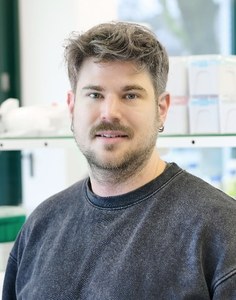 Portrait: Center for Biochemistry, University of Cologne
As a postdoc in the Demetriades lab he co-authored the study showing that lysosomal and cytoplasmic mTORC1 respond to different amino acid sources (FER2024) and the discovery that malonyl-CoA binds the mTOR catalytic pocket and inhibits mTORC1 (NIC2023). His own interest is how mTORC1 and nutrient signals control protein secretion and the extracellular matrix, a topic he co-leads with Demetriades in the DFG research unit FOR2722 (project D3).
He studied biology at the University of Cologne and did his PhD at the Center for Biochemistry of its Medical Faculty. Since January 2024 he leads his own group there, studying how post-translational modifications control secretion and upkeep of the extracellular matrix in disease and ageing.
Milestones in the Atlas
A selection, not a full bibliography: only papers that meet the Atlas inclusion criteria.
| Year | Evidence | Study |
|---|---|---|
| 2023 | M | Malonyl-CoA is a conserved endogenous ATP-competitive mTORC1 inhibitor NIC2023 Co-author: malonyl-CoA acts as a conserved ATP-competitive mTORC1 inhibitor. |
| 2024 | M | Spatial and functional separation of mTORC1 signalling in response to different amino acid sources FER2024 Co-author: spatially separate lysosomal and cytoplasmic mTORC1 pools respond to different amino acid sources. |
Co-authors in the Atlas
People with a profile here who share at least one study with Julian Nüchel.
- Peter Gollwitzer 2 shared studies First author of the 'Rag dimer code' study showing that the four Rag GTPase paralogues are not interchangeable: RagC/D sets substrate choice and RagA/B sets the response to amino acid withdrawal.
- Stephanie A. Fernandes 2 shared studies First author of the study showing that lysosomal and cytoplasmic pools of mTORC1 respond to different amino acid sources and phosphorylate different substrates.
- Claudio De Virgilio Yeast geneticist whose lab found the EGO/Rag GTPase complex that activates TORC1 and showed that the SEACIT complex (Iml1–Npr2–Npr3) switches TORC1 off by acting as a GAP for the Rag GTPase Gtr1.
- Jiyoung Pan PhD student who co-authored the 2024 study showing that mTORC1 does different jobs at the lysosome and away from it, and first author of a 2026 review on why mTORC1 is better seen as a substrate-selective kinase than an on/off switch
- Sabine Wilhelm Co-author on two Demetriades-lab studies of amino acid sensing by mTORC1: the Rag GTPase dimer code and the spatial split of mTORC1 signalling.
Every researcher with a profile →
Thank you. Your answer was counted anonymously.
Thank you. That helps us know which pages have been read by someone who knows the work.
Thank you. We will check it and correct the page.