Constantinos Demetriades
Discovered that starvation drives TSC2 to the lysosome to shut off mTORC1 — a universal stress brake on cell growth
BSc, Aristotle Univ. of Thessaloniki (2003) · PhD, BSRC 'Alexander Fleming' & Aristotle Univ. (George Mosialos lab, 2003–2009) · postdoc, DKFZ Heidelberg (Aurelio Teleman lab, 2010–2016) · Max Planck Research Group Leader, MPI for Biology of Ageing, Cologne (since 2017)
Max Planck Research Group Demetriades, Max Planck Institute for Biology of Ageing, Cologne ↗
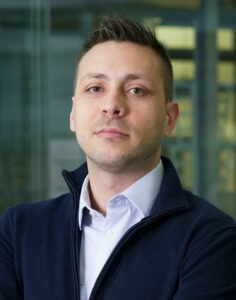 Portrait: Max Planck Institute for Biology of Ageing
As Teleman-lab postdoc, showed (DEM2014) starvation pulls TSC2 onto the lysosome to directly switch off Rheb/mTORC1 — the missing piece beyond Rag-GTPase relocation. Follow-up (DEM2016): many stress types (energy, hypoxia, osmotic, oxidative, growth-factor withdrawal) independently drive TSC2 to the lysosome — a general damage-control mechanism.
Own MPI-AGE group since 2017 (ERC Starting Grant), continuing to dissect the spatial logic of mTORC1 signaling (2024: mTORC1 does different jobs at different locations). FEBS Young Scientists' Fellowship (2014), Walther Flemming Award (2019).
Milestones in the Atlas
| Year | Evidence | Study |
|---|---|---|
| 2014 | M | Regulation of TORC1 in response to amino acid starvation via lysosomal recruitment of TSC2 DEM2014 Amino-acid starvation recruits TSC2 to the lysosome to inactivate Rheb and mTORC1. |
| 2016 | M | Lysosomal recruitment of TSC2 is a universal response to cellular stress DEM2016 Lysosomal TSC2 recruitment is a universal response to many cellular stresses. |