Monther Abu-Remaileh
Worked out how to isolate lysosomes fast enough to measure what is inside them, and found that mTOR controls what gets out
Assistant Professor of Chemical Engineering and of Genetics, Stanford University · postdoctoral research, Whitehead Institute and MIT, in David Sabatini's laboratory (to 2019) · PhD in Molecular Genetics, The Hebrew University of Jerusalem (2014)
Abu-Remaileh Lab, Stanford University (Stanford, California, USA) ↗ Lab lineagetrained under David M. Sabatini → Bluesky@abu-remaileh.bsky.social ↗ ORCID0000-0003-3772-0477 ↗
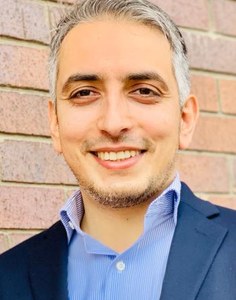 Portrait: Sarafan ChEM-H, Stanford University
The lysosome is where mTORC1 is switched on, so what is inside it matters — but lysosomal metabolites turn over in seconds, and conventional fractionation is far too slow to catch them. ABU2017 solves the measurement problem first: a rapid immunoprecipitation method that pulls lysosomes out of a cell in minutes, followed by metabolite profiling of the isolated organelles.
The biology that follows reverses an arrow the Atlas draws. Blocking the v-ATPase raised the luminal concentration of most metabolites but left most essential amino acids alone. Nutrient starvation did change them, and the effect traced back to mTOR: inhibiting mTOR strongly reduced the efflux of essential amino acids from the lysosome, converting the organelle into a store. So the lysosome is not only the platform that activates mTORC1; mTORC1 also decides what the lysosome releases.
His laboratory at Stanford works on how cells and organisms adapt to metabolic stress, with the lysosome at the centre and with applications in cancer and in neurodegeneration, including lysosomal storage disorders.
Milestones in the Atlas
A selection, not a full bibliography: only papers that meet the Atlas inclusion criteria.
| Year | Evidence | Study |
|---|---|---|
| 2017 | M | KICSTOR recruits GATOR1 to the lysosome and is necessary for nutrients to regulate mTORC1 WOL2017 KICSTOR tethers GATOR1 to the lysosome, required for nutrient control of mTORC1. |
| 2017 | M | mTORC1 Activator SLC38A9 Is Required to Efflux Essential Amino Acids from Lysosomes and Use Protein as a Nutrient WYA2017 SLC38A9 effluxes essential amino acids (e.g. leucine) from lysosomes to activate mTORC1. |
| 2017 | M | Lysosomal metabolomics reveals V-ATPase- and mTOR-dependent regulation of amino acid efflux from lysosomes ABU2017 First author: rapid lysosome isolation plus metabolomics shows mTOR controls the efflux of essential amino acids from the lysosome. |
| 2018 | M | NUFIP1 is a ribosome receptor for starvation-induced ribophagy WYA2018 Co-author: lysosome proteomics after mTORC1 inhibition identifies NUFIP1 as a receptor for starvation-induced ribophagy. |
| 2019 | M | Structural basis for the docking of mTORC1 on the lysosomal surface ROG2019 3.2-angstrom cryo-EM structure of Raptor bound to Rag-Ragulator, showing how Raptor reads out the nutrient-dependent nucleotide state of the Rag GTPases: one part of Raptor senses RagA's nucleotide state, a separate 'claw' senses RagC's, and both have to be in the correct nutrient-signalling combination before Raptor is allowed to dock. Mutating the contact points blocks mTORC1 from reaching the lysosome and inhibits its signalling, which is the functional evidence behind the structural claim. Combined with a separate structure of mTORC1 bound to its activator Rheb, the paper builds a model of the complete, active mTORC1 sitting on the lysosome. Boundary: cryo-EM of a complex reconstituted from purified human proteins, not a live-cell measurement. |
Co-authors in the Atlas 16
People with a profile here who share at least one study with Monther Abu-Remaileh.
ShowHide
- David M. Sabatini 4 shared studies Identified mTOR (as RAFT1) in 1994. His lab then mapped much of the machinery around it: raptor and rictor at the core of mTORC1 and mTORC2, the Rag–Ragulator system that docks mTORC1 on the lysosome, and the sensors that detect leucine, arginine and SAM
- Gregory A. Wyant 3 shared studies Showed that the lysosomal protein SLC38A9 exports leucine and other essential amino acids out of the lysosome, letting cells grow on proteins they have taken up and broken down there
- Nouf N. Laqtom 3 shared studies Cell biologist who helped develop methods to purify intact lysosomes and used them to find what the Batten disease gene CLN3 does, and who now runs a lab at KAUST on lysosome and endoplasmic reticulum defects in rare brain and metabolic diseases
- Elizaveta Freinkman 2 shared studies Chemist and mass-spectrometry specialist at the Whitehead Institute who measured metabolites for many studies of nutrient sensing and cancer metabolism, including the lysosome amino acid work behind two Atlas papers
- Rachel L. Wolfson 2 shared studies Identified Sestrin2 as the direct leucine sensor of the mTORC1 pathway as a Sabatini-lab MD-PhD student. She also co-discovered KICSTOR, the complex that recruits GATOR1 to the lysosome
- Sze Ham Chan 2 shared studies Researcher at the Whitehead Institute who contributed to studies of lysosome contents, nutrient sensing and cancer metabolism, mostly from David Sabatini's lab
- Xin Gu 2 shared studies Cell biologist who discovered SAMTOR, the sensor that lets mTORC1 read the methyl donor SAM, as a PhD student at MIT, and who now leads a lab at Dana-Farber and Harvard Medical School studying ubiquitin-independent protein destruction by the midnolin-proteasome pathway
- Edward J. Brignole Research scientist who directs the cryo-electron microscopy facility at MIT.nano and whose cryo-EM work helped solve the structures of GATOR1, GATOR2 and Raptor docked on the Rag GTPases for the Sabatini lab
- Choah Kim Researcher in David Sabatini's lab at the Whitehead Institute who contributed to three studies on how amino acids at the lysosome are sensed by mTORC1
- Jose M. Orozco Researcher trained in David Sabatini's laboratory at the Whitehead Institute and MIT who showed that mTORC1 senses glucose through the glycolysis metabolite DHAP
- Kacper B. Rogala Solved the near-atomic cryo-EM structure that shows how mTORC1 physically docks at the lysosome by reading the Rag GTPases
- Kendall J. Condon Ran genome-wide CRISPR screens revealing how mitochondrial stress signals to mTORC1
- Kuang Shen Solved, as a Sabatini-lab postdoc, cryo-EM structures of GATOR1 and of the FLCN–FNIP2–Rag–Ragulator complex, two switches that set mTORC1 activity. His UMass Chan lab studies the structural basis of nutrient sensing
- Lynne Chantranupong Showed as a Sabatini-lab graduate student that the Sestrins act through GATOR2 to regulate amino-acid signalling to mTORC1. She then discovered the CASTOR proteins, the cell's arginine sensors for the pathway
- Sonia M. Scaria Contributed, as an MIT undergraduate in the Sabatini lab, to the discovery of CASTOR1 as the arginine sensor and SAMTOR as the SAM sensor of the mTORC1 pathway
- Walter W. Chen Co-author of the 2017 Cell paper showing that SLC38A9 releases essential amino acids from lysosomes to switch on mTORC1
Every researcher with a profile →
Thank you. That helps us know which pages have been read by someone who knows the work.
Thank you. We will check it and correct the page.
Thank you. Your answer was counted anonymously.