Kendall J. Condon
Ran genome-wide CRISPR screens revealing how mitochondrial stress signals to mTORC1
Industry (Bristol Myers Squibb per a public profile, title unverified) · PhD, MIT (Sabatini lab; thesis defended March 2021) · undergrad research in enzyme chemical biology (2014–2015)
PhD (Sabatini lab), MIT Department of Biology (Cambridge, Massachusetts, USA) ↗ Lab lineagetrained under David M. Sabatini → ORCID0000-0002-9515-8892 ↗
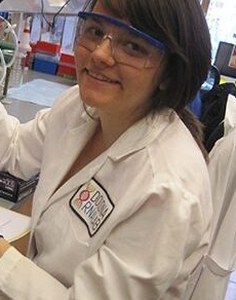 Portrait: UC Berkeley Office for Research (2013)
Fourth author on GU2017 (SAMTOR). Her own thesis (CON2021, PNAS) used genome-wide CRISPR-Cas9 screens to catalogue mTORC1 regulators, converging on mitochondrial function: AMPK and HRI relay mitochondrial distress to mTORC1 on different timescales.
Undergrad chemical biology work included collaborators like Kevan Shokat (DDX3 helicase inhibitors).
Public profile suggests move to Bristol Myers Squibb — not independently confirmed.
Milestones in the Atlas
A selection, not a full bibliography: only papers that meet the Atlas inclusion criteria.
| Year | Evidence | Study |
|---|---|---|
| 2017 | M | KICSTOR recruits GATOR1 to the lysosome and is necessary for nutrients to regulate mTORC1 WOL2017 KICSTOR tethers GATOR1 to the lysosome, required for nutrient control of mTORC1. |
| 2017 | M | SAMTOR is an S-adenosylmethionine sensor for the mTORC1 pathway GU2017 Contributed to SAMTOR biochemistry as a graduate student. |
| 2018 | M | Architecture of the human GATOR1 and GATOR1-Rag GTPases complexes SHE2018 Cryo-EM structures of GATOR1 and GATOR1-Rag complexes reveal GAP and inhibitory-clamp mechanisms. |
| 2021 | M | Genome-wide CRISPR screens reveal multitiered mechanisms through which mTORC1 senses mitochondrial dysfunction CON2021 Led CRISPR screens showing AMPK and HRI relay mitochondrial dysfunction to mTORC1. |
Co-authors in the Atlas 16
People with a profile here who share at least one study with Kendall J. Condon.
ShowHide
- David M. Sabatini 4 shared studies Identified mTOR (as RAFT1) in 1994. His lab then mapped much of the machinery around it: raptor and rictor at the core of mTORC1 and mTORC2, the Rag–Ragulator system that docks mTORC1 on the lysosome, and the sensors that detect leucine, arginine and SAM
- Jose M. Orozco 3 shared studies Researcher trained in David Sabatini's laboratory at the Whitehead Institute and MIT who showed that mTORC1 senses glucose through the glycolysis metabolite DHAP
- Kuang Shen 2 shared studies Solved, as a Sabatini-lab postdoc, cryo-EM structures of GATOR1 and of the FLCN–FNIP2–Rag–Ragulator complex, two switches that set mTORC1 activity. His UMass Chan lab studies the structural basis of nutrient sensing
- Lynne Chantranupong 2 shared studies Showed as a Sabatini-lab graduate student that the Sestrins act through GATOR2 to regulate amino-acid signalling to mTORC1. She then discovered the CASTOR proteins, the cell's arginine sensors for the pathway
- Sonia M. Scaria 2 shared studies Contributed, as an MIT undergraduate in the Sabatini lab, to the discovery of CASTOR1 as the arginine sensor and SAMTOR as the SAM sensor of the mTORC1 pathway
- Xin Gu 2 shared studies Cell biologist who discovered SAMTOR, the sensor that lets mTORC1 read the methyl donor SAM, as a PhD student at MIT, and who now leads a lab at Dana-Farber and Harvard Medical School studying ubiquitin-independent protein destruction by the midnolin-proteasome pathway
- Edward J. Brignole Research scientist who directs the cryo-electron microscopy facility at MIT.nano and whose cryo-EM work helped solve the structures of GATOR1, GATOR2 and Raptor docked on the Rag GTPases for the Sabatini lab
- Grace Y. Liu Wrote with David Sabatini a major 2020 review of mTOR in nutrition, growth and ageing, and in the Sabatini lab studied how mTORC1 senses nutrients such as serine
- Gregory A. Wyant Showed that the lysosomal protein SLC38A9 exports leucine and other essential amino acids out of the lysosome, letting cells grow on proteins they have taken up and broken down there
- J. Wade Harper Co-discovered the F-box motif that links substrates to SCF ubiquitin ligases, and co-leads with Steven Gygi the BioPlex protein-interaction map, which contributed to the discoveries of the CASTOR and SAMTOR nutrient sensors
- Max L. Valenstein First author of the cryo-EM structures of GATOR2, the hub that tells mTORC1 whether amino acids are present, alone and bound to the sensors Sestrin2 and CASTOR1
- Monther Abu-Remaileh Worked out how to isolate lysosomes fast enough to measure what is inside them, and found that mTOR controls what gets out
- Rachel L. Wolfson Identified Sestrin2 as the direct leucine sensor of the mTORC1 pathway as a Sabatini-lab MD-PhD student. She also co-discovered KICSTOR, the complex that recruits GATOR1 to the lysosome
- Rick K. Huang Cryo-electron microscopy specialist who, at the HHMI Janelia Research Campus, helped solve the 2018 and 2019 structures of the protein machines that pass amino acid signals to mTORC1
- Robert A. Saxton Solved, as a Sabatini-lab graduate student, the structures of the leucine sensor Sestrin2 and the arginine sensor CASTOR1, showing how each one grips its amino acid. He also co-wrote a widely cited 2017 review of mTOR signalling with David Sabatini
- Steven P. Gygi Mass-spectrometry scientist whose Harvard lab builds large-scale proteomics methods, including the BioPlex human protein-interaction map, and contributed proteomics to the discoveries of the CASTOR and SAMTOR nutrient sensors
Every researcher with a profile →
Thank you. That helps us know which pages have been read by someone who knows the work.
Thank you. We will check it and correct the page.
Thank you. Your answer was counted anonymously.