Issam Ben-Sahra
Showed as a postdoc in Brendan Manning's lab that mTORC1 drives both pyrimidine and purine synthesis, through two different mechanisms. His Northwestern lab has extended this to bicarbonate import, SAM synthesis and ERK control of purine production
Associate Professor, Northwestern Feinberg (since 2023) · postdoc, Harvard T.H. Chan School (Brendan D. Manning lab) · PhD, Université de Nice Sophia Antipolis (now Université Côte d'Azur), France (Frédéric Bost lab, 2010)
Ben-Sahra Lab, Northwestern University Feinberg School of Medicine (Chicago, Illinois, USA) ↗ Lab lineagetrained under Brendan D. Manning → Bluesky@bensahralab.bsky.social ↗ ORCID0000-0001-9333-4162 ↗
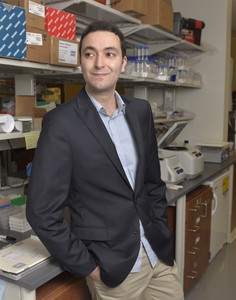 Portrait: Northwestern University Feinberg School of Medicine
As Manning-lab postdoc, showed (BEN2013), in parallel with Michael Hall's lab, that mTORC1–S6K1 switches on de novo pyrimidine synthesis by phosphorylating CAD. Three years later (BEN2016), showed mTORC1 also drives purine synthesis via ATF4-dependent activation of the mitochondrial tetrahydrofolate cycle — completing the picture that mTORC1 controls both nucleotide families.
Trained in Nice, France before Harvard postdoc; now runs his own lab at Northwestern's Lurie Comprehensive Cancer Center studying how growth signaling rewires metabolism in cancer and aging.
Milestones in the Atlas
A selection, not a full bibliography: only papers that meet the Atlas inclusion criteria.
| Year | Evidence | Study |
|---|---|---|
| 2013 | M | Stimulation of de novo pyrimidine synthesis by growth signaling through mTOR and S6K1 BEN2013 mTORC1–S6K1 switches on de novo pyrimidine synthesis by phosphorylating CAD. |
| 2016 | M | mTORC1 induces purine synthesis through control of the mitochondrial tetrahydrofolate cycle BEN2016 mTORC1 drives purine synthesis via ATF4-dependent activation of the mitochondrial tetrahydrofolate cycle. |
| 2020 | M | ERK2 phosphorylates PFAS to mediate posttranslational control of de novo purine synthesis ALI2020 The Atlas records several routes by which mTORC1 drives purine synthesis. This study shows mTORC1 is not the only growth pathway with that power: RAS-ERK signalling stimulates purine synthesis directly and within minutes, because ERK2 - but not ERK1 - phosphorylates the purine synthesis enzyme PFAS at Thr619. Cells expressing a PFAS that cannot be phosphorylated make fewer purines, form fewer colonies and grow smaller tumors. Two points bound the mTOR claim: the control is posttranslational, so it acts far faster than transcription or translation, and it is a parallel input, so purine synthesis in a RAS-driven tumor is not read out from mTORC1 activity alone. |
| 2021 | M | mTORC1 stimulates cell growth through SAM synthesis and m6A mRNA-dependent control of protein synthesis VIL2021 SAMTOR (GU2017) showed the cell can sense S-adenosylmethionine and report it to mTORC1. This study runs the arrow the other way: mTORC1 controls how much SAM the cell makes. Downstream of mTORC1, c-MYC binds intron 1 of MAT2A and raises expression of the enzyme that produces SAM, the cell's main methyl donor; mTORC1 separately increases the protein level of WTAP, the regulatory subunit of the m6A RNA methyltransferase complex. Together these raise m6A methylation of mRNA, which primes the translation machinery for growth. Blocking MAT2A lowers SAM, m6A, protein synthesis rate and tumor growth. |
| 2022 | M | The mTORC1-SLC4A7 axis stimulates bicarbonate import to enhance de novo nucleotide synthesis ALI2022 Building a nucleotide needs a carbon donor, and cells get it from bicarbonate dissolved in their surroundings. This study shows mTORC1 does not just switch on the nucleotide enzymes - it also arranges the delivery of the raw material. Through S6K and the translation factor eIF4B, mTORC1 selectively increases translation of the mRNA for SLC4A7, a sodium-bicarbonate cotransporter, so more bicarbonate is pulled into the cell. Removing SLC4A7 from cells with hyperactive mTORC1 cut flux through both de novo purine and pyrimidine synthesis and slowed cell and tumor growth, without changing intracellular pH - so the transporter matters as a supply line, not as a pH regulator. A fourth distinct route by which mTORC1 feeds nucleotide synthesis, alongside CAD (BEN2013), the mitochondrial folate cycle (BEN2016) and demand coupling (VAL2017). |
Co-authors in the Atlas 8
People with a profile here who share at least one study with Issam Ben-Sahra.
ShowHide
- John M. Asara 5 shared studies Mass-spectrometry specialist whose core facility supplied metabolomics and proteomics for several mTOR studies, including measurements of purine, pyrimidine and SAM metabolism downstream of mTORC1.
- Brendan P. O'Hara 3 shared studies As lab manager of Issam Ben-Sahra's lab at Northwestern, contributed to its studies of how mTORC1 and ERK control nucleotide synthesis, SAM production and bicarbonate import
- Eunus S. Ali 3 shared studies Showed as a Ben-Sahra-lab postdoc that ERK2 directly activates the purine-synthesis enzyme PFAS, and that mTORC1 increases bicarbonate import through SLC4A7 to fuel nucleotide synthesis. His Kentucky lab studies how growth signals control nucleotide metabolism in cancer
- Peng Gao 3 shared studies Directs the Northwestern metabolomics core that supplied mass-spectrometry metabolite measurements for three Ben-Sahra lab studies on how mTORC1 and ERK signalling drive nucleotide and SAM synthesis.
- Brendan D. Manning 2 shared studies Was among the groups that in 2002 identified TSC2 as a direct target of Akt (MAN2002), linking insulin and PI3K signalling to mTORC1, and later found TBC1D7 as the third subunit of the TSC complex. His lab has shown how mTORC1 turns growth signals into the synthesis of lipids and nucleotides
- Elodie Villa 2 shared studies First author of the study showing that mTORC1 raises production of the methyl donor SAM through MAT2A and boosts m6A mRNA methylation to support protein synthesis and cell growth.
- Umakant Sahu 2 shared studies Showed that the building blocks of RNA also tell mitochondria how fast to burn fuel
- Gerta Hoxhaj Studies how growth signalling through PI3K, AKT and mTOR rewires cell metabolism; as a Manning-lab postdoc she co-authored work on how metformin inhibits mTORC1 in the liver
Every researcher with a profile →
On the programme
Meetings in the Atlas calendar where Issam Ben-Sahra is listed among the speakers or organisers.
- past Prague Metabolism and Signaling Symposium 2026 ↗ 24–27 Jun 2026 ·
 Prague, Czech Republic · ★★★
All meetings in the calendar →
Thank you. That helps us know which pages have been read by someone who knows the work.
Thank you. We will check it and correct the page.
Thank you. Your answer was counted anonymously.