Umakant Sahu
Showed that the building blocks of RNA also tell mitochondria how fast to burn fuel
Assistant Professor, Department of Biochemical Engineering and Biotechnology, Indian Institute of Technology Delhi (since 2026) · Research Assistant Professor, Department of Biochemistry and Molecular Genetics, Northwestern University Feinberg School of Medicine (2024–2026) · postdoc, Issam Ben-Sahra lab, Northwestern University Feinberg School of Medicine and Robert H. Lurie Comprehensive Cancer Center (2017–2024) · PhD, Indian Institute of Science, Bengaluru (Pundi N. Rangarajan lab)
Department of Biochemical Engineering and Biotechnology, Indian Institute of Technology Delhi (New Delhi, India) ↗ ORCID0000-0002-7269-4430 ↗
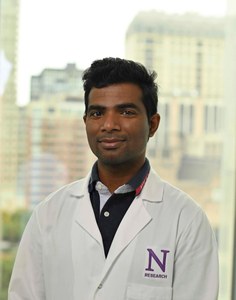 Portrait: Ben-Sahra Lab, Northwestern University
Nucleotides are usually described as the letters of DNA and RNA, and little else. Sahu's own headline finding is that one of them moonlights as a fuel-gauge signal. Working at Northwestern, he showed that UTP – a pyrimidine nucleotide – is the preferred partner of the enzyme TPK1, which manufactures thiamine pyrophosphate, the active form of vitamin B1. Mitochondria need that cofactor for pyruvate dehydrogenase, the enzyme that converts pyruvate into acetyl-CoA. So when a cell runs short of pyrimidines, TPK1 slows, the cofactor thins out, pyruvate oxidation drops, and the cell stops making new fat. A shortage of RNA letters becomes, several steps later, a shortage of lipid.
That result grew out of several years spent mapping how growth signalling arranges nucleotide supply in Issam Ben-Sahra's lab. In ALI2020 he worked on the discovery that ERK2 acts directly on the purine-synthesis enzyme PFAS – a fast chemical modification of the enzyme rather than a slow change in how much of it the cell makes. In VIL2021 he helped trace a different thread: mTORC1 pushes up production of SAM, the cell's universal methyl donor, and through it the m6A marks placed on mRNA, which in turn set the pace of protein synthesis.
He came to this from an unlikely direction. His PhD at the Indian Institute of Science in Bengaluru was on the methylotrophic yeast Pichia pastoris, where he characterised the zinc-finger transcription factor Mxr1p as a master switch for how the yeast handles methanol, acetate and amino acids as carbon sources. Since June 2026 he has run his own group at IIT Delhi, using metabolomics, lipidomics, proteomics and CRISPR screens to ask how these regulatory circuits go wrong in metabolic disease.
Milestones in the Atlas
| Year | Evidence | Study |
|---|---|---|
| 2020 | M | ERK2 phosphorylates PFAS to mediate posttranslational control of de novo purine synthesis ALI2020 Second author; contributed to the finding that ERK2 phosphorylates the purine-synthesis enzyme PFAS, a fast posttranslational route to nucleotide supply running parallel to mTORC1. |
| 2021 | M | mTORC1 stimulates cell growth through SAM synthesis and m6A mRNA-dependent control of protein synthesis VIL2021 Second author; helped show that mTORC1 raises SAM synthesis and m6A mRNA modification to control the rate of protein synthesis. |
Co-authors in the Atlas
People with a profile here who share at least one study with Umakant Sahu.
- Brendan P. O'Hara 2 shared studies As lab manager of Issam Ben-Sahra's lab at Northwestern, contributed to its studies of how mTORC1 and ERK control nucleotide synthesis, SAM production and bicarbonate import
- Eunus S. Ali 2 shared studies Showed as a Ben-Sahra-lab postdoc that ERK2 directly activates the purine-synthesis enzyme PFAS, and that mTORC1 increases bicarbonate import through SLC4A7 to fuel nucleotide synthesis. His Kentucky lab studies how growth signals control nucleotide metabolism in cancer
- Issam Ben-Sahra 2 shared studies Showed as a postdoc in Brendan Manning's lab that mTORC1 drives both pyrimidine and purine synthesis, through two different mechanisms. His Northwestern lab has extended this to bicarbonate import, SAM synthesis and ERK control of purine production