Eunus S. Ali
Showed as a Ben-Sahra-lab postdoc that ERK2 directly activates the purine-synthesis enzyme PFAS, and that mTORC1 increases bicarbonate import through SLC4A7 to fuel nucleotide synthesis. His Kentucky lab studies how growth signals control nucleotide metabolism in cancer
Assistant Professor of Cancer Metabolism, Department of Toxicology and Cancer Biology, University of Kentucky College of Medicine (since 2024); Markey Cancer Center and Center for Cancer and Metabolism · postdoc, Issam Ben-Sahra lab, Northwestern University Feinberg School of Medicine (2017–2024) · PhD, Flinders University, Adelaide (Greg Barritt lab) · MS, Stockholm University (Göran Widmalm lab)
Ali Lab (Metabolism & Signaling), Department of Toxicology and Cancer Biology, University of Kentucky College of Medicine (Lexington, Kentucky, USA) ↗ Bluesky@eunusali.bsky.social ↗ ORCID0000-0002-9477-3500 ↗
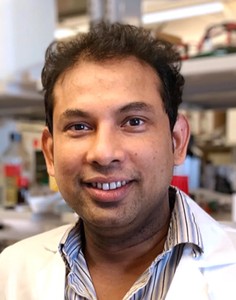 Portrait: Ali Lab, University of Kentucky
A dividing cell needs nucleotides, and nucleotides need carbon. Ali showed in ALI2022 that mTORC1 does not only switch on the enzymes that build them – it also organises the delivery of the raw material. Through S6K and the translation factor eIF4B, mTORC1 selectively raises translation of the mRNA for SLC4A7, a sodium-bicarbonate cotransporter, so the cell pulls in more bicarbonate from its surroundings. Take SLC4A7 away from cells with hyperactive mTORC1 and flux through both purine and pyrimidine synthesis drops, along with cell and tumour growth – and the internal pH does not budge, so the transporter is acting as a supply line, not as a pH valve.
Two years earlier he had drawn a boundary around the same claim. In ALI2020 he found that the other big growth pathway reaches purine synthesis by its own route: ERK2, but not its close relative ERK1, phosphorylates the enzyme PFAS at threonine 619. Because this is a direct modification of the enzyme rather than a change in how much of it is made, the effect lands within minutes. A cell with a PFAS that cannot be phosphorylated makes fewer purines, forms fewer colonies and grows smaller tumours – so in a RAS-driven tumour, purine supply cannot be read from mTORC1 activity alone.
He trained as a carbohydrate chemist in Stockholm and then as a liver physiologist at Flinders, where he worked on how fat accumulation deranges calcium handling in hepatocytes, before joining Issam Ben-Sahra at Northwestern. There he also contributed to VIL2021, which turned the SAM story around: the Atlas already had SAMTOR as a sensor of S-adenosylmethionine, and that paper showed mTORC1 also controls how much SAM the cell makes. Since 2024 he has run his own laboratory at the University of Kentucky, asking how tumours keep their nucleotide supply running and where that supply can be cut.
Milestones in the Atlas
| Year | Evidence | Study |
|---|---|---|
| 2020 | M | ERK2 phosphorylates PFAS to mediate posttranslational control of de novo purine synthesis ALI2020 First author; found that ERK2 phosphorylates PFAS at T619, a fast, posttranslational route to purine synthesis that runs parallel to mTORC1. |
| 2021 | M | mTORC1 stimulates cell growth through SAM synthesis and m6A mRNA-dependent control of protein synthesis VIL2021 Co-author on the study showing mTORC1 raises SAM production and WTAP levels to tune m6A mRNA modification and protein synthesis. |
| 2022 | M | The mTORC1-SLC4A7 axis stimulates bicarbonate import to enhance de novo nucleotide synthesis ALI2022 First author; showed mTORC1 drives SLC4A7 translation to import bicarbonate and keep de novo purine and pyrimidine synthesis running. |
Co-authors in the Atlas
People with a profile here who share at least one study with Eunus S. Ali.
- Brendan P. O'Hara 3 shared studies As lab manager of Issam Ben-Sahra's lab at Northwestern, contributed to its studies of how mTORC1 and ERK control nucleotide synthesis, SAM production and bicarbonate import
- Issam Ben-Sahra 3 shared studies Showed as a postdoc in Brendan Manning's lab that mTORC1 drives both pyrimidine and purine synthesis, through two different mechanisms. His Northwestern lab has extended this to bicarbonate import, SAM synthesis and ERK control of purine production
- Umakant Sahu 2 shared studies Showed that the building blocks of RNA also tell mitochondria how fast to burn fuel