Brendan P. O'Hara
As lab manager of Issam Ben-Sahra's lab at Northwestern, contributed to its studies of how mTORC1 and ERK control nucleotide synthesis, SAM production and bicarbonate import
Associate Director, Lab Manager, Dispatch Bio (since 2022) · Research Lab Manager, Issam Ben-Sahra lab, Department of Biochemistry and Molecular Genetics, Northwestern University Feinberg School of Medicine (2019–2022) · research and postdoctoral-affairs roles, St. Jude Children's Research Hospital, Memphis (2006–2019), including the Department of Genetics · MSc, Biochemistry, University of Bath
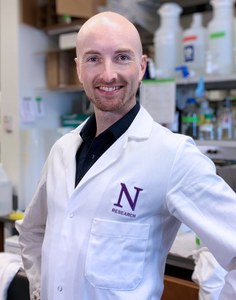 Portrait: Ben-Sahra Lab, Northwestern University
Behind almost every fast-moving metabolism lab there is someone who keeps the cell lines alive, the reagents stocked and the experiments reproducible – and who is often at the bench doing the work as well. For three years that person in Issam Ben-Sahra's lab at Northwestern was Brendan O'Hara, and his name sits on the run of papers that mapped how growth signalling arranges the supply of nucleotides: the ERK2–PFAS link (ALI2020), the SAM and m6A route from mTORC1 to protein synthesis (VIL2021), and the mTORC1–SLC4A7 bicarbonate import axis (ALI2022).
He arrived there from St. Jude Children's Research Hospital in Memphis, where he spent more than a decade in research and postdoctoral-affairs roles. In the Department of Genetics he was a co-author on the 2018 report proposing mTORC3 – a third, rapamycin-insensitive mTOR assembly built around the transcription factor ETV7, offered as one explanation for why rapamycin so often disappoints as a cancer drug. That claim remains debated, but it is a reminder that the standard two-complex picture of mTOR has been challenged from inside the field.
Since 2022 he has worked in industry, as lab manager at the cancer-immunotherapy start-up Dispatch Bio, while continuing to appear as a co-author on work begun at Northwestern – including the 2024 study showing that matrix stiffness pushes cells to accumulate sorbitol, which then helps proteins condense into droplets.
Milestones in the Atlas
| Year | Evidence | Study |
|---|---|---|
| 2020 | M | ERK2 phosphorylates PFAS to mediate posttranslational control of de novo purine synthesis ALI2020 Co-author on the discovery that ERK2 phosphorylates PFAS at T619, speeding up purine synthesis without changing how much enzyme is present. |
| 2021 | M | mTORC1 stimulates cell growth through SAM synthesis and m6A mRNA-dependent control of protein synthesis VIL2021 Co-author on the study linking mTORC1 to SAM synthesis, m6A mRNA modification and the control of protein synthesis. |
| 2022 | M | The mTORC1-SLC4A7 axis stimulates bicarbonate import to enhance de novo nucleotide synthesis ALI2022 Co-author; contributed to the work showing mTORC1 raises SLC4A7 translation to import bicarbonate for de novo purine and pyrimidine synthesis. |
Co-authors in the Atlas
People with a profile here who share at least one study with Brendan P. O'Hara.
- Eunus S. Ali 3 shared studies Showed as a Ben-Sahra-lab postdoc that ERK2 directly activates the purine-synthesis enzyme PFAS, and that mTORC1 increases bicarbonate import through SLC4A7 to fuel nucleotide synthesis. His Kentucky lab studies how growth signals control nucleotide metabolism in cancer
- Issam Ben-Sahra 3 shared studies Showed as a postdoc in Brendan Manning's lab that mTORC1 drives both pyrimidine and purine synthesis, through two different mechanisms. His Northwestern lab has extended this to bicarbonate import, SAM synthesis and ERK control of purine production
- Umakant Sahu 2 shared studies Showed that the building blocks of RNA also tell mitochondria how fast to burn fuel