Markus A. Rüegg
Neurobiologist at the Biozentrum of the University of Basel who studies how muscles and the nerve connections that drive them develop, age and fail, including the role of mTOR signalling in muscle.
University of Basel · Professor of Neurobiology (since 2004) · Co-founder and CEO, SEAL Therapeutics (since 2021) · Postdoctoral fellow, Stanford University (1989–1992)
Rüegg Group, Biozentrum, University of Basel (Basel, Switzerland) ↗ ORCID0000-0002-4974-9384 ↗
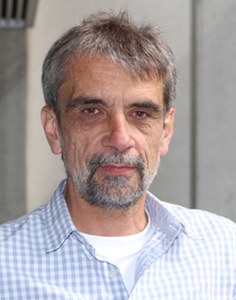 Portrait: Biozentrum, University of Basel
Markus Rüegg is a professor of neurobiology at the Biozentrum of the University of Basel. He studied biochemistry at the University of Zurich and was a postdoctoral fellow in the neurobiology department at Stanford University School of Medicine from 1989 to 1992. Back in Basel he became assistant professor (1992 to 1997), associate professor (1998 to 2004) and full professor (since 2004). His group studies how the junction between nerve and muscle is built and kept up, how muscle ages, and muscular dystrophies. Since 2021 he has also been co-founder and CEO of SEAL Therapeutics.
His main Atlas study is from 2008. First author C. Florian Bentzinger, working in the labs of Rüegg and Michael Hall, removed raptor (a part of mTORC1) or rictor (a part of mTORC2) only in the skeletal muscle of mice. Muscles without raptor slowly became dystrophic, burned fuel less efficiently, and the mice did not live as long. Muscles without rictor looked normal. The result showed that muscle needs mTORC1 but not mTORC2, and it is how mTOR entered his muscle work.
He is also a co-author on three studies from Hall's group at the Biozentrum. In 2004 the group showed in mouse cells that a second mTOR complex, mTORC2, exists. It is not blocked by rapamycin and helps control the actin cytoskeleton, the protein scaffold that gives a cell its shape. In 2008, mice that lacked raptor only in fat tissue stayed lean and burned more energy in their mitochondria. In 2012, mice that lacked rictor only in the liver could not switch the liver from making glucose to using it after a meal, and they developed high blood sugar and low blood fats. All four Atlas findings come from mice and cultured cells, not from people.
Milestones in the Atlas
A selection, not a full bibliography: only papers that meet the Atlas inclusion criteria.
| Year | Evidence | Study |
|---|---|---|
| 2004 | M | Mammalian TOR complex 2 controls the actin cytoskeleton and is rapamycin insensitive JAC2004 Middle author of the paper that described mTORC2 in mammalian cells, together with Michael Hall and colleagues at the Biozentrum. |
| 2008 | A | Skeletal muscle-specific ablation of raptor, but not of rictor, causes metabolic changes and results in muscle dystrophy BEN2008 Showed that deleting raptor (mTORC1) in mouse skeletal muscle causes dystrophy and metabolic changes, whereas deleting rictor (mTORC2) does not; Rüegg was senior author. |
| 2008 | A | Adipose-specific knockout of raptor results in lean mice with enhanced mitochondrial respiration POL2008 Middle author of the paper showing that removing raptor from fat tissue makes mice lean. |
| 2012 | A | Hepatic mTORC2 activates glycolysis and lipogenesis through Akt, glucokinase, and SREBP1c HAG2012 Middle author of the paper showing that liver-specific loss of rictor disturbs how the liver handles glucose and fat. |
Co-authors in the Atlas 10
People with a profile here who share at least one study with Markus A. Rüegg.
ShowHide
- Michael N. Hall 4 shared studies Discovered TOR in yeast in 1991 and established it as a central controller of cell growth that responds to nutrients. His lab later showed that TOR works in two distinct complexes, TORC1 and TORC2, only one of which is blocked by rapamycin
- Nadine Cybulski 2 shared studies Cell biologist from Michael Hall's Basel lab who showed that mTORC2 in fat tissue helps control how big the whole body grows
- Asami Hagiwara First author of a 2012 mouse study from Michael Hall's lab showing that liver mTORC2 tells the liver that the animal has eaten, by switching on sugar breakdown and fat production
- C. Florian Bentzinger Muscle stem cell biologist at the Université de Sherbrooke who, as a PhD student in Basel, showed that mTORC1 but not mTORC2 is essential for healthy skeletal muscle
- Estela Jacinto Co-discovered mammalian mTORC2 as a postdoc in Michael Hall's lab, showing that it controls the actin cytoskeleton and is insensitive to rapamycin. Her Rutgers lab, with Bing Su's group, was among those that found SIN1 holds mTORC2 together and studies how both mTOR complexes control metabolism
- Charles Betz Traced mTORC2 to a specific address inside the cell — the mitochondria-ER contact site
- Marion Cornu Physiologist from Michael Hall's Basel lab who showed in mice that mTORC1 in the liver controls body temperature, movement and fat metabolism through the hormone FGF21
- Pazit Polak Cell biologist from Michael Hall's Basel lab who showed, in mice, that switching off mTORC1 in fat tissue alone makes animals lean and protects them from diet-induced obesity
- Robbie Loewith Showed, as first author in Michael Hall's lab, that yeast TOR exists as two distinct complexes, the basis of the TORC1/TORC2 framework
- Shuo Lin Co-author of the 2008 mouse study showing that muscle needs raptor, the mTORC1 component, to stay healthy
Every researcher with a profile →
Thank you. That helps us know which pages have been read by someone who knows the work.
Thank you. We will check it and correct the page.
Thank you. Your answer was counted anonymously.