Nadine Cybulski
Cell biologist from Michael Hall's Basel lab who showed that mTORC2 in fat tissue helps control how big the whole body grows
Biozentrum, University of Basel, Michael N. Hall lab (2008–2014, most recent confirmed affiliation) · PhD, University of Basel (2010, with Michael N. Hall) · later address in Montreal, Canada (2014) · current position not confirmed
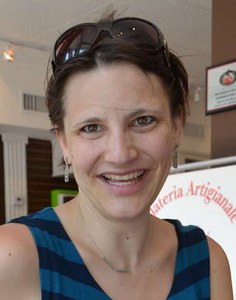 Portrait: Biozentrum, University of Basel
Nadine Cybulski is a co-author of two Atlas mouse studies from Michael Hall's lab. In 2008, mice lacking raptor, an essential part of mTORC1, only in fat tissue stayed lean, resisted diet-induced obesity and burned more energy in their fat. In 2012, mice lacking rictor, the core of mTORC2, only in the liver could not switch the liver to its fed-state programme, so it kept making glucose and made less fat. Both are mouse results.
Cybulski did a PhD in Hall's lab at the Biozentrum. The thesis, "New insights into the 'in vivo' and 'in vitro' functions of mammalian TOR complex 2", was accepted by the University of Basel in 2010, supervised by Hall with Markus Ruegg as co-referee. Cybulski's main paper, as first author in PNAS in 2009, removed rictor from fat tissue. The mice grew larger overall, with bigger organs such as heart, kidney and bone. The mice had high insulin and raised levels of the growth factor IGF1 and its partner protein IGFBP3. The study showed that mTORC2 in fat tissue acts as a brake on growth of the whole body. With Hall, Cybulski also wrote a 2009 review, "TOR complex 2: a signaling pathway of its own", and described mouse cells in which raptor or rictor can be switched off on demand, a tool used by many labs.
Cybulski also co-authored studies with Oded Meyuhas's group in Jerusalem on how mTOR controls translation of a class of messenger RNAs called TOP mRNAs. A 2014 paper gives a later address in Montreal, Canada. A current position could not be confirmed.
Milestones in the Atlas
A selection, not a full bibliography: only papers that meet the Atlas inclusion criteria.
| Year | Evidence | Study |
|---|---|---|
| 2008 | A | Adipose-specific knockout of raptor results in lean mice with enhanced mitochondrial respiration POL2008 Co-author: fat-specific loss of raptor gave lean mice with more energy use in their fat. |
| 2012 | A | Hepatic mTORC2 activates glycolysis and lipogenesis through Akt, glucokinase, and SREBP1c HAG2012 Co-author: liver-specific loss of mTORC2 caused high blood sugar and insulin in mice. |
Co-authors in the Atlas 6
People with a profile here who share at least one study with Nadine Cybulski.
ShowHide
- Markus A. Rüegg 2 shared studies Neurobiologist at the Biozentrum of the University of Basel who studies how muscles and the nerve connections that drive them develop, age and fail, including the role of mTOR signalling in muscle.
- Michael N. Hall 2 shared studies Discovered TOR in yeast in 1991 and established it as a central controller of cell growth that responds to nutrients. His lab later showed that TOR works in two distinct complexes, TORC1 and TORC2, only one of which is blocked by rapamycin
- Asami Hagiwara First author of a 2012 mouse study from Michael Hall's lab showing that liver mTORC2 tells the liver that the animal has eaten, by switching on sugar breakdown and fat production
- Charles Betz Traced mTORC2 to a specific address inside the cell — the mitochondria-ER contact site
- Marion Cornu Physiologist from Michael Hall's Basel lab who showed in mice that mTORC1 in the liver controls body temperature, movement and fat metabolism through the hormone FGF21
- Pazit Polak Cell biologist from Michael Hall's Basel lab who showed, in mice, that switching off mTORC1 in fat tissue alone makes animals lean and protects them from diet-induced obesity
Every researcher with a profile →
Thank you. That helps us know which pages have been read by someone who knows the work.
Thank you. We will check it and correct the page.
Thank you. Your answer was counted anonymously.