Pankaj Kapahi
Showed that reducing TOR signalling extends fruit-fly lifespan, and that the translation repressor 4E-BP is needed for dietary restriction to extend it
Professor, Buck Institute for Research on Aging · postdoc, Caltech (S. Benzer) · postdoc, UC San Diego (M. Karin) · PhD, Univ. of Manchester (T. Kirkwood)
Kapahi Lab, Buck Institute for Research on Aging (Novato, California, USA) ↗ Lab lineagetrained under Michael Karin → Bluesky@pkapahi.bsky.social ↗ ORCID0000-0002-5629-4947 ↗
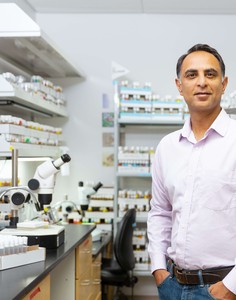 Portrait: Buck Institute for Research on Aging
In Benzer's lab (KAP2004), showed genetically reducing TOR pathway activity (via TSC1/TSC2, TOR, S6K) extends fly lifespan, overlapping mechanistically with dietary restriction. In 2009 (ZID2009), closed the loop: dietary restriction upregulates the TOR target 4E-BP, which selectively boosts mitochondrial gene translation — required, not just correlated, for the lifespan extension.
Nathan Shock New Investigator Award (2010), NIA EUREKA Award (2010), Julie Martin Mid-Career Award (2011), Glenn Award (2015).
Milestones in the Atlas
A selection, not a full bibliography: only papers that meet the Atlas inclusion criteria.
| Year | Evidence | Study |
|---|---|---|
| 2004 | A | Regulation of lifespan in Drosophila by modulation of genes in the TOR signaling pathway KAP2004 Genetically dialing down TOR in Drosophila extends lifespan, overlapping with dietary restriction. |
| 2009 | A | 4E-BP extends lifespan upon dietary restriction by enhancing mitochondrial activity in Drosophila ZID2009 Dietary restriction upregulates the TOR target 4E-BP, which boosts mitochondrial translation and is required for the lifespan extension. |
| 2013 | A | Late-life rapamycin treatment reverses age-related heart dysfunction FLY2013 Striking evidence that in mice mTOR inhibition doesn't just SLOW aging - it can partly reverse an established age-related phenotype. Giving rapamycin to already-old (24-month) female mice for 3 months improved aged heart function, reversing or attenuating age-related cardiac changes, with RNA-seq changes suggesting anti-hypertrophic and anti-inflammatory effects. Started late, still worked. |
| 2015 | M | mTOR regulates the pro-tumorigenic senescence-associated secretory phenotype by promoting IL1A translation LAB2015 Explained HOW rapamycin calms 'inflammaging'. Senescent cells spew inflammatory signals (the SASP) that damage surrounding tissue and even feed tumors. mTOR powers this by translating IL1A, the cytokine at the top of the cascade. Rapamycin selectively shuts it down - and blocked senescent cells from fueling prostate tumor growth in mice. |
Co-authors in the Atlas 9
People with a profile here who share at least one study with Pankaj Kapahi.
ShowHide
- Seymour Benzer 2 shared studies Pioneer of fine-structure gene mapping in phage and founder of neurogenetics, whose Drosophila work found the first circadian-rhythm mutants
- Brian K. Kennedy Showed with Matt Kaeberlein that reducing TOR or Sch9 signalling extends yeast lifespan in the same way as dietary restriction, and has since championed mTOR as a target for slowing human ageing
- Brian M. Zid Biochemist at UC San Diego who studies how cells decide which messenger RNAs to translate under stress, and who showed as a Caltech student that the mTOR target 4E-BP is needed for dietary restriction to lengthen fly lifespan
- James M. Flynn Aging researcher from Simon Melov's lab at the Buck Institute who showed that a short course of rapamycin late in life can partly reverse heart aging in mice
- Judith Campisi Pioneer of research on cellular senescence and the senescence-associated secretory phenotype (SASP); her 2015 paper showed that mTOR drives the inflammatory SASP.
- Randy Strong Leads the San Antonio site of the NIA Interventions Testing Program, which tests each compound in parallel at three sites under one shared protocol. He first-authored the program's reports on resveratrol and other supplements (2012) and on rapamycin combined with acarbose (2022)
- Remi-Martin Laberge Biologist of cell senescence, trained in Judith Campisi's lab, who showed how mTOR drives the inflammatory signals of senescent cells and then moved to drug development against senescence at UNITY Biotechnology
- Simon Melov Geroscientist who studies how cells and tissues change with age or drug treatment, including the finding that late-life rapamycin improves heart function in old mice.
- Yuji Ikeno Pathologist at the Barshop Institute for Longevity and Aging Studies in San Antonio whose examinations of tissues from aged mice help ageing studies tell whether an intervention changes disease, especially cancer, late in life
Every researcher with a profile →
On the programme
Meetings in the Atlas calendar where Pankaj Kapahi is listed among the speakers or organisers.
- upcoming Gordon Research Conference: Biology of Aging 2027 ↗ 25–30 Jul 2027 ·
 Lucca (Barga), Italy · ★★ Add to calendar:
Google ·
Apple / Outlook
All meetings in the calendar →
Thank you. That helps us know which pages have been read by someone who knows the work.
Thank you. We will check it and correct the page.
Thank you. Your answer was counted anonymously.