Seymour Benzer
Pioneer of fine-structure gene mapping in phage and founder of neurogenetics, whose Drosophila work found the first circadian-rhythm mutants
Boswell Professor of Neuroscience, Emeritus, Caltech · 1921–2007 (deceased) · Wolf Prize, Lasker Award, Crafoord Prize, National Medal of Science
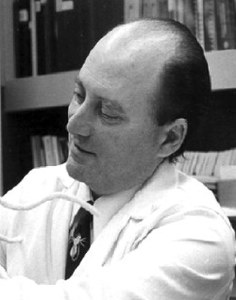 Portrait: Wikimedia Commons (archival photo)
Seymour Benzer began as a physicist. He took a PhD at Purdue in 1947, then moved into biology after reading Schrödinger's What Is Life?, working with Max Delbrück at Caltech and later at the Pasteur Institute. In the 1950s he used mutant bacteriophages to map the inside of a single gene, showing that a gene is divisible and that mutations are spread along it.
From the 1960s at Caltech he turned to behaviour and used the fruit fly to ask which genes shape it. His laboratory found the first circadian-rhythm mutants and identified genes such as per (the biological clock) and dunce (learning). His honours include the Lasker Award, Wolf Prize, Crafoord Prize and National Medal of Science, and he was a member of the National Academy of Sciences and the Royal Society. He died in 2007.
In the Atlas he appears as a co-author of ZID2009, a Drosophila study from Pankaj Kapahi's group. It found that the mTOR target 4E-BP is switched on by dietary restriction and is needed for the lifespan gain, partly by boosting mitochondrial gene translation. The fly was Benzer's own model organism, and this is a late paper in a long career.
Milestones in the Atlas
A selection, not a full bibliography: only papers that meet the Atlas inclusion criteria.
| Year | Evidence | Study |
|---|---|---|
| 2009 | A | 4E-BP extends lifespan upon dietary restriction by enhancing mitochondrial activity in Drosophila ZID2009 Co-author of the Drosophila study showing that 4E-BP, a target of mTOR, mediates lifespan extension under dietary restriction by enhancing mitochondrial activity. |
Co-authors in the Atlas
People with a profile here who share at least one study with Seymour Benzer.
- Pankaj Kapahi Showed that reducing TOR signalling extends fruit-fly lifespan, and that the translation repressor 4E-BP is needed for dietary restriction to extend it
Every researcher with a profile →
Thank you. Your answer was counted anonymously.
Thank you. That helps us know which pages have been read by someone who knows the work.
Thank you. We will check it and correct the page.