Nahum Sonenberg
Co-discovered the mRNA cap-binding protein eIF4E and the 4E-BP proteins that restrain it, and showed how mTOR releases this brake to control protein synthesis
Distinguished James McGill Professor of Biochemistry and Gilman Cheney Chair, McGill University; member, Rosalind and Morris Goodman Cancer Institute · joined McGill University (1979) · postdoc, Roche Institute of Molecular Biology (Aaron Shatkin lab) · PhD, Weizmann Institute of Science (1976) · BSc & MSc in microbiology and immunology, Tel Aviv University
Faculty profile, McGill University (Montreal, Quebec, Canada) ↗ Lab lineagetrained under Aaron J. Shatkin →
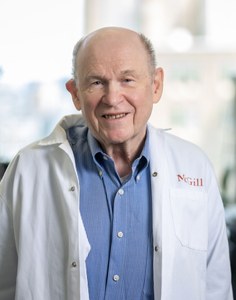 Portrait: Goodman Cancer Institute, McGill University
In 1999, Sonenberg's group worked out how the translational repressor 4E-BP1 is actually switched off: rather than being phosphorylated all at once, it is modified through an ordered, priming two-step mechanism, in which phosphorylation at certain sites must occur before others can follow, and only the fully phosphorylated protein releases its grip on the cap-binding protein eIF4E. Since eIF4E is the factor that recognizes the 5' cap of mRNA and recruits it into the ribosome, this phosphorylation cascade — which sits downstream of mTORC1 — acts as a molecular switch that turns on cap-dependent protein synthesis when nutrients and growth signals are abundant. In 2013, his lab extended this logic to metabolism, showing that mTORC1, acting specifically through 4E-BP-dependent control of translation, regulates the biogenesis and activity of mitochondria.
Sonenberg did his PhD at the Weizmann Institute of Science and then a postdoctoral fellowship with Aaron Shatkin at the Roche Institute of Molecular Biology, where the two identified eIF4E, the protein that binds the 5' cap of messenger RNA — the discovery that set the direction for his entire career studying translational control. He joined McGill University's Department of Biochemistry in 1979 and has remained there since.
Sonenberg is a Fellow of the Royal Society, an Officer of the Order of Canada, and a Foreign Associate of the US National Academy of Sciences; his honors include the Gairdner Foundation International Award and the Wolf Prize in Medicine. He currently holds the Gilman Cheney Chair in Biochemistry at McGill and is a member of the Rosalind and Morris Goodman Cancer Institute.
Milestones in the Atlas
A selection, not a full bibliography: only papers that meet the Atlas inclusion criteria.
| Year | Evidence | Study |
|---|---|---|
| 1999 | M | Regulation of 4E-BP1 phosphorylation: a novel two-step mechanism GIN1999 Shows that 4E-BP1 phosphorylation follows an ordered, priming two-step mechanism that determines when 4E-BP1 releases eIF4E to permit cap-dependent translation. |
| 2002 | M | A rapamycin-sensitive signaling pathway contributes to long-term synaptic plasticity in the hippocampus TAN2002 Co-author: mTOR, the 4E-BPs and eIF4E sit in hippocampal dendrites near synapses, and rapamycin reduced late-phase LTP and BDNF-induced potentiation in rodent hippocampal slices. |
| 2009 | R | Translational control of long-lasting synaptic plasticity and memory COS2009 Senior author of a narrative review on how the mTORC1 and eIF2alpha pathways control the start of translation in long-lasting synaptic plasticity and long-term memory. |
| 2012 | M | Distinct perturbation of the translatome by the antidiabetic drug metformin LAR2012 Senior author: shows metformin reshapes the translatome in cancer cells through mTORC1 and 4E-BPs, selectively lowering translation of cell-cycle mRNAs. |
| 2013 | A | Autism-related deficits via dysregulated eIF4E-dependent translational control GKO2013 Senior author: mice lacking 4E-BP2 showed autism-like behaviours with increased translation of neuroligin mRNAs, and blocking eIF4E reversed the social deficit. |
| 2013 | M | mTORC1 controls mitochondrial activity and biogenesis through 4E-BP-dependent translational regulation MOR2013 Shows that mTORC1 controls mitochondrial biogenesis and activity specifically through 4E-BP-dependent regulation of translation. |
Co-authors in the Atlas 11
People with a profile here who share at least one study with Nahum Sonenberg.
ShowHide
- Anne-Claude Gingras 2 shared studies Showed in 1999 that mTOR phosphorylates 4E-BP1 in a priming two-step mechanism, and now leads work on interaction proteomics (including BioID) that maps how cells read signals such as mTORC1
- Davide Ruggero Showed that oncogenic mTOR signalling reprograms which mRNAs are translated, and that tumours become addicted to this through the 4E-BP–eIF4E axis. His UCSF lab found that mTOR-driven translation of a specific set of mRNAs promotes prostate cancer invasion and metastasis
- Erin M. Schuman Studies how neurons make and break down proteins locally in dendrites and axons; her group helped tie a rapamycin-sensitive mTOR pathway to the protein-synthesis-dependent phase of synaptic plasticity.
- Christos G. Gkogkas Studies how protein synthesis is controlled in the brain; first author of the mouse study linking loss of the translational repressor 4E-BP2, downstream of mTORC1, to autism-like behaviour through increased neuroligin translation.
- Julie St-Pierre Biochemist and Vice-President, Research and Innovation at the University of Ottawa who studies how cancer cells adapt their metabolism, and a co-author on McGill work linking mTORC1 to mitochondria and to rapamycin-induced fatty liver
- Masahiro Morita Biochemist at UT Health San Antonio who studies how mTORC1 controls protein synthesis, mRNA decay and mitochondria, and how these links go wrong in cancer and metabolic disease
- Mauro Costa-Mattioli Neuroscientist who studies how mTOR signaling and protein synthesis control learning, memory and brain function, including the role of mTORC2 in long-term memory.
- Ola Larsson Studies how mRNA translation is altered in cancer and develops methods to measure genome-wide translation; helped show that metformin changes which mRNAs cancer cells translate, through the mTORC1/4E-BP pathway.
- Robert T. Abraham Co-discovered the mammalian target of rapamycin in 1995, giving it the name mTOR, and showed that it directly phosphorylates the translation repressor 4E-BP1 (PHAS-I)
- Shao-Jun Tang Neuroscientist who, as a postdoc in Erin Schuman's group at Caltech, helped show that a rapamycin-sensitive mTOR pathway is needed for the protein-synthesis-dependent late phase of hippocampal LTP; his lab now studies chronic pain.
- Steven P. Gygi Mass-spectrometry scientist whose Harvard lab builds large-scale proteomics methods, including the BioPlex human protein-interaction map, and contributed proteomics to the discoveries of the CASTOR and SAMTOR nutrient sensors
Every researcher with a profile →
Thank you. That helps us know which pages have been read by someone who knows the work.
Thank you. We will check it and correct the page.
Thank you. Your answer was counted anonymously.