Ashley M. Thelen
Cell biologist who did graduate work in Roberto Zoncu's lysosome lab at UC Berkeley, first author of a 2017 review on the lysosome's roles in lipid metabolism, and later a postdoctoral scholar in Philip Greenberg's lab at Fred Hutch
Postdoctoral scholar, Philip Greenberg lab, Fred Hutchinson Cancer Center, Seattle (per Zoncu lab alumni page) · graduate student, Zoncu Lab, Department of Molecular and Cell Biology, University of California, Berkeley (about 2017–2019)
Lab lineagetrained under Roberto Zoncu →
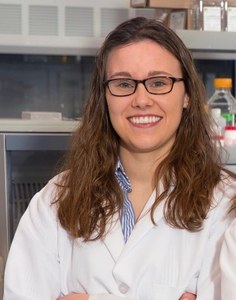 Portrait: UC Berkeley Department of Molecular and Cell Biology
Ashley Thelen is a co-author of two Zoncu lab papers in this Atlas. mTORC1, the growth-control complex, is switched on at the surface of the lysosome, the cell's recycling compartment, when nutrients are present. CAS2017 showed that cholesterol inside the lysosome is one of these nutrient signals: the protein SLC38A9 is needed for cholesterol to switch mTORC1 on, and NPC1, which moves cholesterol out of the lysosome and is faulty in Niemann-Pick type C disease, holds the signal back. The experiments used cell lines and patient fibroblasts. LAW2019 solved the structure of the folliculin complex, FLCN with its partner FNIP2, bound to the Rag GTPases and Ragulator on the lysosome. Folliculin acts as a checkpoint that switches on one of the Rag proteins, RagC, which mTORC1 needs to be recruited. Loss of FLCN causes Birt-Hogg-Dubé syndrome, an inherited condition with kidney tumours.
Together the two papers show how mTORC1 reads the state of the lysosome: what nutrients it holds, and whether the Rag switch on its surface is in the 'on' position. Both are cell and protein studies.
Thelen did graduate work in Roberto Zoncu's lab at UC Berkeley, which studies how the lysosome senses nutrients. There Thelen was first author of a 2017 Trends in Cell Biology review, written with Zoncu, on the emerging roles of the lysosome in lipid metabolism, and co-authored a 2019 Molecular Biology of the Cell paper from Schekman's lab at Berkeley on how an autophagy-specific PI3-kinase complex controls LC3 lipidation, an early step in building autophagosomes. The Zoncu lab's alumni list gives Thelen's next position as postdoctoral scholar in Philip Greenberg's lab at the Fred Hutchinson Cancer Center in Seattle.
Milestones in the Atlas
A selection, not a full bibliography: only papers that meet the Atlas inclusion criteria.
| Year | Evidence | Study |
|---|---|---|
| 2017 | M | Lysosomal cholesterol activates mTORC1 via an SLC38A9-Niemann-Pick C1 signaling complex CAS2017 Co-author of the study showing that lysosomal cholesterol activates mTORC1 through SLC38A9 and NPC1. |
| 2019 | M | Structural mechanism of a Rag GTPase activation checkpoint by the lysosomal folliculin complex LAW2019 Co-author of the structural study showing the folliculin complex as a checkpoint for Rag GTPase activation. |
Co-authors in the Atlas 11
People with a profile here who share at least one study with Ashley M. Thelen.
ShowHide
- Brian M. Castellano Cell biologist who, in Roberto Zoncu's lab at UC Berkeley, showed that cholesterol inside the lysosome switches on mTORC1 through the SLC38A9 and NPC1 proteins
- Daniel K. Nomura Chemical biologist and professor at UC Berkeley who uses chemoproteomics to find druggable sites on proteins, including covalent handles that turn ordinary drug molecules into protein degraders
- Do Jin Kim Structural biologist, now at Denali Therapeutics, who worked in James Hurley's lab at UC Berkeley on the protein machines of autophagy and on the Rag-Ragulator complex that brings mTORC1 to the lysosome
- Douglas F. Covey Medicinal chemist and Andrew C and Barbara B Taylor Distinguished Professor of Psychiatry at Washington University in St. Louis who designs synthetic steroids and sterols to study neurosteroids, GABA-A receptors and cholesterol sensing, including in two Atlas studies on cholesterol and mTORC1
- Chun-Yan Lim Cell biologist who trained in Roberto Zoncu's lab at UC Berkeley on how cholesterol controls mTORC1, and now publishes as corresponding author from Guangzhou National Laboratory on lysosome signalling in immunity and nutrient sensing
- James H. Hurley Structural biologist who uses cryo-EM to show how protein machines assembled on membranes control autophagy and nutrient signalling. His lab solved structures of the Rag–Ragulator complex and of the whole mTORC1–TFEB–Rag–Ragulator assembly on the lysosome
- Ofer Moldavski Researcher who worked on lysosomes and lipid signalling in Roberto Zoncu's lab at UC Berkeley and was first author of a 2021 study on how the oxysterol 4beta-hydroxycholesterol switches on fat-making genes
- Oliver B. Davis Cell biologist who did a PhD in Roberto Zoncu's lab at UC Berkeley on how lysosomal cholesterol controls mTORC1, and first author of a 2020 study proposing NPC1-mTORC1 signalling as a drug target in Niemann-Pick type C disease
- Roberto Zoncu Showed as a postdoc that mTORC1 senses amino acids from inside the lysosome, through the v-ATPase and Ragulator. His Berkeley lab has since mapped how the Rag GTPases and the folliculin complex switch mTORC1 on, and how lysosomal cholesterol feeds into the same system
- Rosalie E. Lawrence Working in Roberto Zoncu's lab, uncovered the nutrient-driven affinity switch and the FLCN checkpoint that gate mTORC1 activation at the lysosome
- Rushika M. Perera Professor of Anatomy at UCSF whose lab studies how autophagy and the lysosome, the cell's recycling centre, help cancer cells cope with stress, and a co-author of two Science papers on how lysosomal cholesterol switches on mTORC1
Every researcher with a profile →
Thank you. That helps us know which pages have been read by someone who knows the work.
Thank you. We will check it and correct the page.
Thank you. Your answer was counted anonymously.