Penny Lovat
Professor of Cellular Dermatology and Oncology at Newcastle University who studies autophagy in melanoma, and whose work on the autophagy protein AMBRA1 and the skin protein loricrin underlies a test, developed with AMLo Biosciences, to identify early melanomas at low risk of spreading
Professor of Cellular Dermatology and Oncology, Translational and Clinical Research Institute, Newcastle University · Chief Scientific Officer, AMLo Biosciences, Newcastle upon Tyne
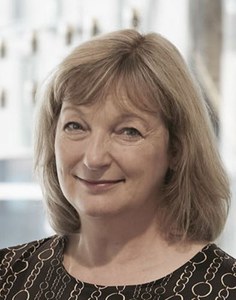 Portrait: European Society for Dermatological Research (ESDR 2026)
Penny Lovat is a co-author of two Atlas papers from Viktor Korolchuk's lab at Newcastle University on why ageing cells behave as they do. CAR2017 showed that in senescent human cells (cells that have permanently stopped dividing) mTORC1, the growth-control complex, stays switched on even when nutrients or growth factors are taken away. The fault lies upstream, in how the cells sense amino acids and growth signals, and the cells come to depend on this signal to survive. KEL2024 showed that healthy human cells constantly recycle damaged mitochondria (basal mitophagy), that this stops when cells become senescent, and that part of rapamycin's anti-ageing effect on cells needs mitophagy to be restored. Both studies were done in cultured human cells.
Lovat's own research centres on autophagy, the cell's recycling system, in skin cancer. PubMed lists her at Newcastle University on more than 50 papers on melanoma and autophagy. Her group found that the autophagy regulator AMBRA1 and the skin barrier protein loricrin are lost from the skin above melanomas that are more likely to spread. With collaborators in Rome she showed that the HPV virus breaks down AMBRA1 in throat cancers, which lowers autophagy and makes the tumour cells easier to kill with cisplatin (2020). A 2026 study tested AMBRA1 and loricrin staining to help pathologists tell high-grade moles from thin melanomas.
Lovat is Professor of Cellular Dermatology and Oncology at Newcastle University and Chief Scientific Officer of AMLo Biosciences, the Newcastle company that brings the AMBRA1 and loricrin test to clinical use. PubMed papers list her at the university's Translational and Clinical Research Institute.
Milestones in the Atlas
A selection, not a full bibliography: only papers that meet the Atlas inclusion criteria.
| Year | Evidence | Study |
|---|---|---|
| 2017 | M | Persistent mTORC1 signaling in cell senescence results from defects in amino acid and growth factor sensing CAR2017 Co-author on the Newcastle study showing that senescent human cells keep mTORC1 switched on because their sensing of amino acids and growth factors is broken. |
| 2024 | M | Suppressed basal mitophagy drives cellular aging phenotypes that can be reversed by a p62-targeting small molecule KEL2024 Co-author on the study showing that loss of basal mitophagy drives cellular ageing and that rapamycin's anti-senescence effect depends on restoring it. |
Co-authors in the Atlas 6
People with a profile here who share at least one study with Penny Lovat.
ShowHide
- Bernadette Carroll 2 shared studies First author of the study showing why mTORC1 stays switched on in senescent cells, and co-author on G3BP–TSC and senescence-mitophagy work; her own lab studies how nutrient sensing breaks down in ageing cells.
- Glyn Nelson 2 shared studies Microscopy specialist who manages Newcastle University's Bioimaging Unit and has worked for many years on the signalling networks that keep senescent cells in their arrested state
- Thomas von Zglinicki 2 shared studies Cell-senescence researcher who co-authored the Newcastle studies on stuck-on mTORC1 in senescent cells and on loss of basal mitophagy as a driver of cellular ageing.
- Viktor I. Korolchuk 2 shared studies Showed that where lysosomes sit inside the cell tunes mTORC1 activity to nutrient supply. His Newcastle lab found that senescent cells can no longer switch mTORC1 off when nutrients or growth factors are withdrawn, and studies how autophagy and mitophagy decline with age
- George Kelly Cell biologist from Viktor Korolchuk's group at Newcastle University who showed that the routine clearing of damaged mitochondria fails as human cells become senescent
- Satomi Miwa Mitochondrial biologist who contributed to Newcastle studies on rapamycin in NF-κB-driven ageing mice and on basal mitophagy as a brake on cellular senescence.
Every researcher with a profile →
Thank you. That helps us know which pages have been read by someone who knows the work.
Thank you. We will check it and correct the page.
Thank you. Your answer was counted anonymously.