Wenyi Wei
Studies how protein stability and cell signalling, including the PI3K-mTOR-AKT network, are controlled in cancer cells.
Professor of Pathology, Beth Israel Deaconess Medical Center & Harvard Medical School (since 2017) · Director, Biochemistry Program, BIDMC Cancer Center (2015) · Postdoc with William Kaelin, Dana-Farber (2002–2005)
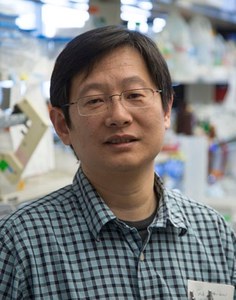 Portrait: Academia Europaea
Wenyi Wei leads a laboratory in the Department of Pathology at Beth Israel Deaconess Medical Center, part of Harvard Medical School. He trained as a PhD student at Brown University with John Sedivy and then as a postdoctoral fellow with William Kaelin at the Dana-Farber Cancer Institute. His research focuses on tumour formation, the cell cycle and cell signalling.
The Atlas includes his 2015 study in Cancer Discovery on how mTORC2 is switched on. mTORC2 is one of the two big mTOR protein complexes, and it activates a growth kinase called AKT. The team found that a part of the SIN1 protein normally holds mTOR back, and that a membrane lipid called PIP3 releases this brake, so mTORC2 turns on when growth signals arrive.
They also showed that mutations found in cancer patients weaken the brake, which raises mTORC2 activity and helps tumours grow. The work links the PI3K signal that sits upstream of AKT directly to mTORC2.
Milestones in the Atlas
A selection, not a full bibliography: only papers that meet the Atlas inclusion criteria.
| Year | Evidence | Study |
|---|---|---|
| 2015 | M | PtdIns(3,4,5)P3-Dependent Activation of the mTORC2 Kinase Complex LIU2015 Showed that the SIN1 PH domain inhibits mTOR and that PIP3 relieves this inhibition to activate mTORC2; Wei was senior and corresponding author. |
Co-authors in the Atlas
People with a profile here who share at least one study with Wenyi Wei.
- Bing Su Immunologist who studies how mTOR and MAPK signaling shape immune regulation and vascular function, and senior author of the study showing that SIN1 is a core part of mTORC2.
- John Blenis Showed early on that rapamycin blocks S6 kinase, then worked out how mTORC1 drives cell growth through its two main translation targets, S6K1 and 4E-BP1. His lab also found, in parallel with the Sabatini lab, that mTORC1 phosphorylates Grb10, a feedback brake on insulin signalling
- Lewis C. Cantley Co-discovered PI3K, the pathway that feeds into mTOR from growth factors
Every researcher with a profile →
Thank you. Your answer was counted anonymously.
Thank you. That helps us know which pages have been read by someone who knows the work.
Thank you. We will check it and correct the page.