Takahiro Nobukuni
Showed as first author that amino acids activate mTOR through the lipid kinase hVps34, by a route separate from insulin signalling through TSC, in parallel with a study from Jonathan Backer's laboratory
Associate Professor, Tohoku Medical Megabank Organization, Tohoku University · Friedrich Miescher Institute for Biomedical Research, Basel (affiliation on NOB2005, 2005)
Tohoku Medical Megabank Organization, Tohoku University (Sendai, Japan) ↗
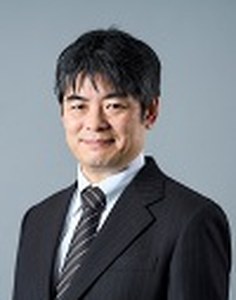 Portrait: Tohoku Medical Megabank Organization, Tohoku University
NOB2005 is written as an argument about evolution as much as about signalling. Its claim is that the amino-acid-driven TOR pathway came first, and that in animals the insulin/class I PI3K pathway was grafted onto it — so the two inputs should not be expected to run through the same machinery. Working in George Thomas's group at the FMI in Basel, Nobukuni showed that the amino acid signal to mTOR/raptor goes through class 3 PI3K (hVps34) rather than through the components of the insulin route.
The result matters for how the Atlas reads its own amino-acid branch. The Rag/Ragulator account that came later describes a different mechanism for the same input, and neither account has displaced the other; the corpus now carries both, with the disagreement stated rather than smoothed over.
His publication record after roughly 2019 is in population-scale health research at the Tohoku Medical Megabank rather than in mTOR signalling.
Milestones in the Atlas
A selection, not a full bibliography: only papers that meet the Atlas inclusion criteria.
| Year | Evidence | Study |
|---|---|---|
| 2003 | M | Insulin activation of Rheb, a mediator of mTOR/S6K/4E-BP signaling, is inhibited by TSC1 and 2 GAR2003 Insulin activates Rheb-GTP, inhibited by TSC1/2, positioning Rheb as the direct upstream activator of TOR. |
| 2005 | M | Amino acids mediate mTOR/raptor signaling through activation of class 3 phosphatidylinositol 3OH-kinase NOB2005 First author: amino acids signal to mTOR/raptor through class 3 PI3K, separately from the insulin/class 1 PI3K route. |
| 2008 | M | Amino acids activate mTOR complex 1 via Ca2+/CaM signaling to hVps34 GUL2008 Co-author: amino acids raise intracellular calcium, which acts through calmodulin and hVps34 to activate mTORC1 (cells). |
Co-authors in the Atlas 8
People with a profile here who share at least one study with Takahiro Nobukuni.
ShowHide
- George Thomas 2 shared studies Purified and cloned S6K1, the kinase that became the classic readout of mTORC1 activity. His lab later showed that mice lacking S6K1 resist diet-induced obesity, and that amino acids signal to mTORC1 through the lipid kinase hVps34 (GUL2008)
- Johannes L. (Hans) Bos 2 shared studies Cancer biologist known for work on Ras mutations and for the small GTPase Rap1 and its activator Epac, a cAMP-regulated switch for cell adhesion
- Sara C. Kozma 2 shared studies Studies the S6K/mTOR pathway and how it controls cell growth, ribosome production, diabetes and cancer, including mTOR signalling in liver cancer.
- Attila Garami First author of the 2003 study, from George Thomas's group at the Friedrich Miescher Institute, showing that insulin switches on Rheb and that the TSC1-TSC2 complex switches it off
- Ernst Hafen Developmental geneticist who used Drosophila to work out how insulin and TOR signalling control cell and body size, including the role of Rheb.
- Jonathan M. Backer Showed that the class III PI 3-kinase hVps34, best known for its role in autophagy, is regulated by nutrients and is needed for amino acids to activate S6 kinase through mTOR, in parallel with George Thomas's group
- Maya P. Byfield Showed as first author that the lipid kinase hVps34 is regulated by nutrients and is needed for amino acids to activate S6 kinase through mTOR, in parallel with a study from George Thomas's group
- Pawan Gulati First author of the study proposing that amino acids activate mTORC1 through a rise in intracellular calcium and calmodulin binding to hVps34, and later of work linking the obesity gene FTO to amino-acid sensing by mTORC1
Every researcher with a profile →
Thank you. That helps us know which pages have been read by someone who knows the work.
Thank you. We will check it and correct the page.
Thank you. Your answer was counted anonymously.