George Thomas
Purified and cloned S6K1, the archetypal mTORC1 substrate
PhD, University of California · Senior Group Leader, Friedrich Miescher Institute, Basel (1979–2004) · Scientific Director, Metabolic Disease Institute, University of Cincinnati
Faculty profile, University of Cincinnati ↗
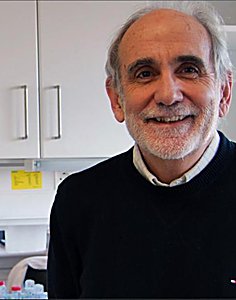 Portrait: IDIBELL
George Thomas spent 25 years at the Friedrich Miescher Institute in Basel, where his lab purified and cloned the cell-growth kinases S6K1 and S6K2 — among the first mTORC1 substrates to be identified — and then worked out much of the upstream signalling that controls them, including the TSC1/TSC2 tumour-suppressor complex.
Since moving to the University of Cincinnati in 2005, his lab has traced S6K1/mTOR signalling into physiology and disease: showing that mice lacking S6K1 resist age- and diet-induced obesity while staying insulin-sensitive, that Rheb activation of mTOR/S6K is inhibited by TSC1/2, and that the diabetes drug metformin can inhibit mTORC1 independently of AMPK, in a Rag-GTPase-dependent manner.
The timeline below follows Thomas's contributions gathered in this Atlas.
Milestones in the Atlas
| Year | Evidence | Study |
|---|---|---|
| 2003 | M | Insulin activation of Rheb, a mediator of mTOR/S6K/4E-BP signaling, is inhibited by TSC1 and 2 GAR2003 Shows insulin activation of Rheb, a mediator of mTOR/S6K/4E-BP signalling, is inhibited by the TSC1/TSC2 complex. |
| 2004 | A | Absence of S6K1 protects against age- and diet-induced obesity while enhancing insulin sensitivity UMX2004 Shows absence of S6K1 protects mice against age- and diet-induced obesity while enhancing insulin sensitivity. |
| 2010 | M | Metformin, independent of AMPK, inhibits mTORC1 in a rag GTPase-dependent manner KAL2010 Shows metformin inhibits mTORC1 independently of AMPK, in a Rag-GTPase-dependent manner. |