Petrus J. de Vries
Child and adolescent psychiatrist at the University of Cape Town known for work on TAND, the behavioural, learning and mental-health problems of tuberous sclerosis complex, and co-author of major everolimus trials in TSC
Sue Struengmann Professor of Child & Adolescent Psychiatry, University of Cape Town · Founding Director, Centre for Autism Research in Africa · President, International Society for Autism Research · earlier clinical and research career in the United Kingdom (PhD, University of Cambridge)
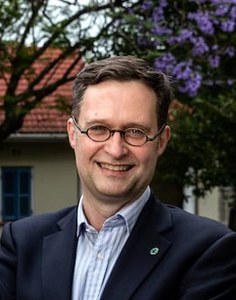 Portrait: The Transmitter (photo Dwayne Senior)
Petrus de Vries appears in this Atlas on two trials of everolimus, an mTOR blocker, in tuberous sclerosis complex (TSC), the genetic disease in which mTORC1 runs unchecked. EXIST-3 (FRE2016) was a large phase 3 trial in 366 children and adults whose focal seizures had not responded to standard drugs. Adding everolimus at a higher blood level halved seizure frequency in 40% of patients, against 15% on placebo, and it became the basis for approving the drug for TSC epilepsy. TRON (SAX2026) asked a harder question in adults: does everolimus improve memory and thinking? Both everolimus and placebo groups improved, so the trial found no clear drug effect on cognition.
de Vries studied medicine at Stellenbosch University in South Africa, then trained in psychiatry and in child and adolescent psychiatry in the United Kingdom and earned a PhD in developmental neuroscience at the University of Cambridge. Work on TSC began in 1997, with a focus on its behavioural, intellectual, psychiatric and learning problems, now grouped under the name TSC-Associated Neuropsychiatric Disorders (TAND), on which de Vries has led international consensus recommendations.
In 2012 de Vries returned to South Africa as the Sue Struengmann Professor of Child and Adolescent Psychiatry at the University of Cape Town and became founding director of the Centre for Autism Research in Africa. Current work covers autism and child mental health in low- and middle-income settings, alongside the TSC programme. In 2014 de Vries received the Manuel R Gomez Award from the TSC community.
Milestones in the Atlas
A selection, not a full bibliography: only papers that meet the Atlas inclusion criteria.
| Year | Evidence | Study |
|---|---|---|
| 2016 | H | Adjunctive everolimus therapy for treatment-resistant focal-onset seizures associated with tuberous sclerosis (EXIST-3): a phase 3, randomised, double-blind, placebo-controlled study FRE2016 Co-author of EXIST-3, the phase 3 trial showing that adjunctive everolimus reduces treatment-resistant seizures in TSC. |
| 2026 | H | Everolimus for the treatment of neuropsychological deficits in tuberous sclerosis complex: findings from the TRON multicentre randomised controlled trial SAX2026 Co-author of the TRON trial report, which found no clear benefit of everolimus over placebo for neuropsychological deficits in TSC. |
Co-authors in the Atlas 5
People with a profile here who share at least one study with Petrus J. de Vries.
ShowHide
- Anurag Saxena Clinical research fellow at Cardiff University who coordinated TRON, a placebo-controlled trial testing whether everolimus improves memory and thinking in adults with tuberous sclerosis complex
- David N. Franz Led the EXIST-1 trial showing that the mTOR inhibitor everolimus shrinks the brain tumours (SEGAs) of tuberous sclerosis, and helped run the first sirolimus trial for its kidney tumours
- Jacqueline A. French Epilepsy clinical-trial specialist; first author of EXIST-3, the placebo-controlled phase 3 trial in which everolimus reduced treatment-resistant seizures in tuberous sclerosis complex.
- Julian R. Sampson Clinical geneticist who led the consortium that identified the TSC2 gene and led trials of mTOR inhibitors in tuberous sclerosis, including the TRON trial of everolimus for cognition.
- Paolo Curatolo Child neurologist at Tor Vergata University in Rome who has spent much of a long career on tuberous sclerosis complex, the genetic disease of overactive mTOR, with a focus on epilepsy and brain development in children
Every researcher with a profile →
Thank you. That helps us know which pages have been read by someone who knows the work.
Thank you. We will check it and correct the page.
Thank you. Your answer was counted anonymously.