Paolo Curatolo
Child neurologist at Tor Vergata University in Rome who has spent much of a long career on tuberous sclerosis complex, the genetic disease of overactive mTOR, with a focus on epilepsy and brain development in children
Child Neurology and Psychiatry Unit, Systems Medicine Department, Tor Vergata University, Rome · Tor Vergata University Hospital (EXIST-3, 2016)
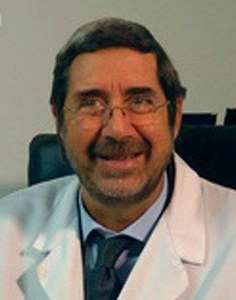 Portrait: Top Doctors Italia
Tuberous sclerosis complex (TSC) is a genetic disease caused by faulty TSC1 or TSC2 genes. These genes normally act as a brake on mTORC1, the growth-control complex, so in TSC mTORC1 runs too high and benign growths form in the brain, kidneys, skin and other organs. Many children with TSC have epilepsy that standard drugs do not control. Paolo Curatolo is a co-author of EXIST-3 (FRE2016), a phase 3, double-blind trial published in the Lancet in 2016 that tested whether everolimus, a drug that blocks mTOR, could reduce these seizures.
The trial enrolled 366 patients aged 2 to 65 with treatment-resistant focal seizures and randomly assigned them to placebo, a low everolimus dose or a high everolimus dose. About 15% of patients on placebo had their seizures cut by half or more, against 28% on the low dose and 40% on the high dose. Because the drug targets the cause of the disease and not just the seizures, EXIST-3 is one of the clearest examples in people of what blocking mTOR can do.
PubMed lists Curatolo on more than 140 papers about tuberous sclerosis. A 2025 review in eBioMedicine, written with colleagues in Rome and Amsterdam, sets out how biomarkers such as EEG findings, gene variants and brain imaging can pick out infants at high risk, and how early treatment with vigabatrin or mTOR inhibitors might prevent the severe epilepsy and developmental problems that often follow. On that paper Curatolo is listed at the Child Neurology and Psychiatry Unit, Systems Medicine Department, Tor Vergata University.
Milestones in the Atlas
A selection, not a full bibliography: only papers that meet the Atlas inclusion criteria.
| Year | Evidence | Study |
|---|---|---|
| 2016 | H | Adjunctive everolimus therapy for treatment-resistant focal-onset seizures associated with tuberous sclerosis (EXIST-3): a phase 3, randomised, double-blind, placebo-controlled study FRE2016 Co-author of the phase 3 EXIST-3 trial showing that everolimus reduces treatment-resistant seizures in tuberous sclerosis complex. |
Co-authors in the Atlas 3
People with a profile here who share at least one study with Paolo Curatolo.
ShowHide
- David N. Franz Led the EXIST-1 trial showing that the mTOR inhibitor everolimus shrinks the brain tumours (SEGAs) of tuberous sclerosis, and helped run the first sirolimus trial for its kidney tumours
- Jacqueline A. French Epilepsy clinical-trial specialist; first author of EXIST-3, the placebo-controlled phase 3 trial in which everolimus reduced treatment-resistant seizures in tuberous sclerosis complex.
- Petrus J. de Vries Child and adolescent psychiatrist at the University of Cape Town known for work on TAND, the behavioural, learning and mental-health problems of tuberous sclerosis complex, and co-author of major everolimus trials in TSC
Every researcher with a profile →
Thank you. That helps us know which pages have been read by someone who knows the work.
Thank you. We will check it and correct the page.
Thank you. Your answer was counted anonymously.