Marcus D. Säemann
Nephrologist who showed that the TSC-mTOR pathway controls the innate inflammatory response
Professor and Chair of Nephrology · Sigmund Freud University Vienna
Chair of Nephrology, Sigmund Freud University Vienna (Vienna, Austria) ↗
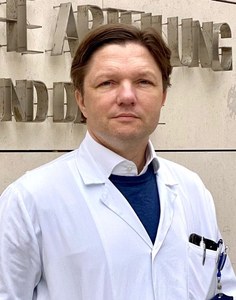 Portrait: Wiener Gesundheitsverbund
Marcus Säemann has held the Chair of Nephrology at Sigmund Freud University in Vienna since 2017. His research interests include the renin-angiotensin system, HDL in kidney failure and diabetes after transplantation. At the time of the Atlas study he was in the Clinical Division of Nephrology and Dialysis at the Medical University of Vienna.
In the Atlas he is senior author of WEI2008 in Immunity. Blocking mTOR with rapamycin, or removing TSC2, changed how monocytes and macrophages respond to bacteria: blocking mTOR boosted inflammatory messengers through NF-κB and cut the calming messenger IL-10, while losing TSC2 did the opposite. This showed that the TSC-mTOR pathway is a regulator of innate immunity, not only of cell growth.
Milestones in the Atlas
A selection, not a full bibliography: only papers that meet the Atlas inclusion criteria.
| Year | Evidence | Study |
|---|---|---|
| 2008 | M | The TSC-mTOR signaling pathway regulates the innate inflammatory response WEI2008 Senior author: the TSC-mTOR pathway regulates the inflammatory response of monocytes and macrophages (mouse and human cells). |
Co-authors in the Atlas 1
People with a profile here who share at least one study with Marcus D. Säemann.
ShowHide
- Thomas Weichhart Immunologist who showed that mTOR sets the tone of the innate immune response, and now studies how macrophage metabolism drives granulomatous disease
Every researcher with a profile →
Thank you. That helps us know which pages have been read by someone who knows the work.
Thank you. We will check it and correct the page.
Thank you. Your answer was counted anonymously.