Vamsi K. Mootha
Studies how mitochondria are built and work and how their genes cause disease, including the MitoCarta inventory of the mitochondrial proteome and the mitochondrial calcium uniporter.
Investigator, Howard Hughes Medical Institute · Professor of Systems Biology, Harvard Medical School · Massachusetts General Hospital & Broad Institute · Member, National Academy of Sciences
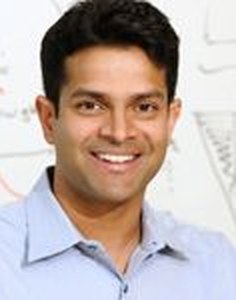 Portrait: Harvard Medical School
Vamsi Mootha is a physician-scientist who studies mitochondria, the structures that make most of a cell's usable energy. His lab at Massachusetts General Hospital, Harvard Medical School and the Broad Institute combines biochemistry and physiology with genomics and proteomics. It produced MitoCarta, a catalogue of the proteins in mitochondria, and helped define parts of the mitochondrial calcium uniporter. He is an HHMI investigator and a member of the National Academy of Sciences.
CUN2007 is a Nature paper led by John Cunningham and Pere Puigserver, with Mootha as a co-author. It showed that mTOR is needed to keep mitochondria working well. Rapamycin lowered the activity of genes that drive mitochondria and reduced oxygen use in muscle, and the effect ran through the transcription factor YY1 and its partner PGC-1alpha.
The Atlas includes it because it tied mTOR to energy production, not only to protein building and cell growth.
Milestones in the Atlas
A selection, not a full bibliography: only papers that meet the Atlas inclusion criteria.
| Year | Evidence | Study |
|---|---|---|
| 2007 | M | mTOR controls mitochondrial oxidative function through a YY1-PGC-1alpha transcriptional complex CUN2007 Co-author of the Nature study showing that mTOR controls mitochondrial gene expression and respiration through a YY1-PGC-1alpha complex. |
Co-authors in the Atlas
People with a profile here who share at least one study with Vamsi K. Mootha.
- Pere Puigserver Metabolism researcher who studies how mitochondrial energy production and nutrient metabolism are controlled, including the finding that mTOR drives mitochondrial gene activity through YY1 and PGC-1alpha.
Every researcher with a profile →
Thank you. Your answer was counted anonymously.
Thank you. That helps us know which pages have been read by someone who knows the work.
Thank you. We will check it and correct the page.