Tsuneo Ikenoue
Gastroenterologist and cancer researcher at the University of Tokyo who trained in Kun-Liang Guan's mTOR lab and now builds mouse models of liver, bile duct and pancreatic cancer driven by the PI3K-Akt-mTOR pathway
Associate Professor, Institute of Medical Science, University of Tokyo (grant records 2010–2022) · Assistant Professor, University of Tokyo Hospital (2012) · research fellow, Kun-Liang Guan lab, Life Sciences Institute, University of Michigan (papers 2006–2009)
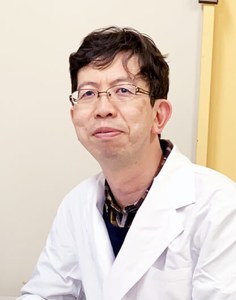 Portrait: Furukawa Laboratory, Institute of Medical Science, University of Tokyo
mTOR works inside two different protein complexes. mTORC1 controls growth, and mTORC2 adds a phosphate group to the survival protein Akt. In 2006 it was still unclear which parts were essential for mTORC2. The Atlas study YAN2006, from Kun-Liang Guan's lab at the University of Michigan, showed that a protein called Sin1 is one of them. Without Sin1, mTOR and its partner Rictor did not stay together, and the complex could not phosphorylate Akt. Tsuneo Ikenoue was one of the co-authors.
In the Guan lab Ikenoue worked on the same signalling network from several angles. A 2008 paper with Ken Inoki and Guan, with Ikenoue as first author, showed that the tumour suppressor PTEN carries an acetyl tag that changes which partner proteins it binds. Ikenoue also contributed to Michigan studies on mTOR in hypothalamic neurons that control appetite, on the TSC-mTOR pathway in resting T cells, and on Rictor and mTORC2 in blood stem cells and leukaemia.
Back in Japan, Ikenoue is an associate professor at the Institute of Medical Science of the University of Tokyo, according to national grant records that run to 2022. The grants cover gastroenterology and cancer genetics: genetically engineered mice in which Kras activation and loss of Pten cause bile duct cancer, autophagy in Kras-driven pancreatic cancer, and mutations that act through the PI3K-Akt-mTORC1 pathway.
Milestones in the Atlas
A selection, not a full bibliography: only papers that meet the Atlas inclusion criteria.
| Year | Evidence | Study |
|---|---|---|
| 2006 | M | Identification of Sin1 as an essential TORC2 component required for complex formation and kinase activity YAN2006 Co-author of the Guan-lab study showing that Sin1 is required for mTORC2 to assemble and to phosphorylate Akt. |
Co-authors in the Atlas 3
People with a profile here who share at least one study with Tsuneo Ikenoue.
ShowHide
- Ken Inoki Showed as a postdoc in Kun-Liang Guan's lab that Akt switches off TSC2, that TSC2 is the off-switch (GAP) for the small GTPase Rheb, and that AMPK and GSK3 feed energy and Wnt signals into the same brake. His Michigan lab studies mTOR signalling in metabolism and kidney disease
- Kun-Liang Guan Showed how growth-factor and energy signals reach mTORC1 through TSC2 and Rheb, and, in parallel with the Sabatini lab, that the Rag GTPases carry the amino-acid signal. His lab also found that AMPK and mTORC1 control autophagy by phosphorylating the kinase ULK1 at different sites
- Qian Yang Researcher in Kun-Liang Guan's Michigan lab and first author of the 2006 study that identified Sin1 as an essential part of mTOR complex 2
Every researcher with a profile →
Thank you. That helps us know which pages have been read by someone who knows the work.
Thank you. We will check it and correct the page.
Thank you. Your answer was counted anonymously.