Sue C. Bodine
Showed that turning on the Akt-mTOR pathway is enough, by itself, to make skeletal muscle grow and to stop it from wasting away
PhD, UCLA (V. Reggie Edgerton lab, 1985) · Lab Director, Regeneron Pharmaceuticals (1996–2003) · Professor, UC Davis (2003–2017) · Professor, University of Iowa Carver College of Medicine (2017–2023) · Professor, OMRF (since 2023) · President, American Physiological Society (2026)
Aging & Metabolism Research Program, Oklahoma Medical Research Foundation (OMRF) ↗
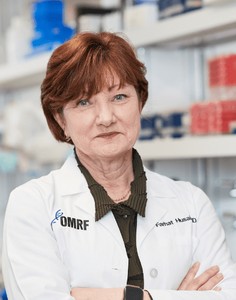 Portrait: Oklahoma Medical Research Foundation (OMRF)
In back-to-back 2001 Nature Cell Biology papers, Bodine's Regeneron group (BOD2001) and a companion Rommel et al. study (ROM2001, on which she was key author) established that activating Akt/mTOR is sufficient by itself to trigger muscle hypertrophy and prevent atrophy in vivo — rapamycin blocked hypertrophy in every model tested.
Bodine trained under V. Reggie Edgerton at UCLA (including Soviet Bion space-biology missions), directed muscle/nerve regeneration research at Regeneron, then built labs at UC Davis and University of Iowa extending the findings into disuse atrophy, sarcopenia, and atrogin-1/MuRF1 E3 ligases.
Since 2023 at OMRF; began a term as American Physiological Society president in 2026.
Milestones in the Atlas
| Year | Evidence | Study |
|---|---|---|
| 2001 | A | Akt/mTOR pathway is a crucial regulator of skeletal muscle hypertrophy and can prevent muscle atrophy in vivo BOD2001 Activating Akt/mTOR alone triggers skeletal-muscle hypertrophy and blocks disuse atrophy; rapamycin blocks hypertrophy in every model. |
| 2001 | M | Mediation of IGF-1-induced skeletal myotube hypertrophy by PI(3)K/Akt/mTOR and PI(3)K/Akt/GSK3 pathways ROM2001 IGF-1 drives myotube hypertrophy specifically through PI3K/Akt/mTOR and PI3K/Akt/GSK3. |