Diego L. Medina
Cell biologist at the Telethon Institute of Genetics and Medicine in Naples who showed how TFEB, the master switch for lysosome genes, is controlled by calcium released from lysosomes, and who works on lysosomal storage diseases
Telethon Institute of Genetics and Medicine (TIGEM), Pozzuoli · Department of Translational Medical Science, University of Naples Federico II (papers 2011–2026)
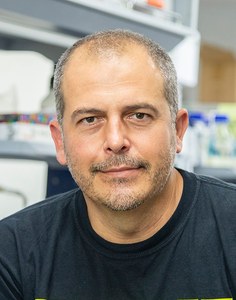 Portrait: TIGEM (Telethon Institute of Genetics and Medicine)
Diego Medina is a co-author of the 2012 EMBO Journal paper from Andrea Ballabio's group at TIGEM (SET2012) that showed how the lysosome, the cell's recycling compartment, talks to the nucleus. When nutrients are plentiful, mTORC1, the growth-control complex, sits on the lysosome surface and adds a phosphate group to the transcription factor TFEB, which keeps TFEB outside the nucleus. When mTORC1 is blocked, when the cell is starved, or when lysosomes are under stress, TFEB moves into the nucleus and switches on genes for new lysosomes and for autophagy. The study was done in cultured cells and gave a simple explanation of how cells match their recycling capacity to their needs.
Medina's own first-author papers fill in other parts of the TFEB story. A 2011 Developmental Cell paper showed that TFEB also drives lysosomal exocytosis, in which lysosomes fuse with the cell surface and empty their contents outside, and that this cleared stored material in models of lysosomal storage diseases. A 2015 Nature Cell Biology paper showed that calcium released from the lysosome through the channel MCOLN1 switches on the phosphatase calcineurin, which removes the phosphate that mTORC1 put on TFEB, so TFEB can enter the nucleus. In mice this route was needed for TFEB activation during starvation and exercise.
PubMed lists Medina at TIGEM in Pozzuoli, near Naples, on more than 50 papers, and in 2026 also at the Department of Translational Medical Science of the University of Naples Federico II, on work on autophagy and inflammation in intestinal organoids from people with coeliac disease.
Milestones in the Atlas
A selection, not a full bibliography: only papers that meet the Atlas inclusion criteria.
| Year | Evidence | Study |
|---|---|---|
| 2012 | M | A lysosome-to-nucleus signalling mechanism senses and regulates the lysosome via mTOR and TFEB SET2012 Co-author of the study showing that mTORC1 phosphorylates TFEB on the lysosome and that blocking mTORC1 sends TFEB into the nucleus to switch on lysosome genes. |
Co-authors in the Atlas 5
People with a profile here who share at least one study with Diego L. Medina.
ShowHide
- Andrea Ballabio Discovered that the transcription factor TFEB is a master switch for building lysosomes (SAR2009) and for autophagy. His lab was one of the groups that showed in 2012 that mTORC1 keeps TFEB out of the nucleus from the lysosome surface, and later (2020) that constitutive TFEB activation drives the kidney disease of Birt-Hogg-Dubé syndrome
- Carmine Settembre Showed, as first author in Andrea Ballabio's lab, that TFEB drives autophagy as well as lysosome production, and, in parallel with other groups, that mTORC1 phosphorylates TFEB at the lysosome to keep this program switched off when nutrients are plentiful
- David M. Sabatini Identified mTOR (as RAFT1) in 1994. His lab then mapped much of the machinery around it: raptor and rictor at the core of mTORC1 and mTORC2, the Rag–Ragulator system that docks mTORC1 on the lysosome, and the sensors that detect leucine, arginine and SAM
- Roberto Zoncu Showed as a postdoc that mTORC1 senses amino acids from inside the lysosome, through the v-ATPase and Ragulator. His Berkeley lab has since mapped how the Rag GTPases and the folliculin complex switch mTORC1 on, and how lysosomal cholesterol feeds into the same system
- Tuong Huynh Research associate at Baylor College of Medicine in Houston and co-author on a long run of papers from Andrea Ballabio's group on TFEB, the master switch for lysosome and autophagy genes, including the work that tied TFEB to mTOR, starvation and fat metabolism
Every researcher with a profile →
Thank you. That helps us know which pages have been read by someone who knows the work.
Thank you. We will check it and correct the page.
Thank you. Your answer was counted anonymously.