Pranav V. Lalgudi
Co-author of the cryo-EM structures of GATOR2, the nutrient-sensing hub of mTORC1, in 2022 and of GATOR2 bound to Sestrin2 and CASTOR1 in 2025
PhD student, Genetics, Stanford University School of Medicine (since 2022) · Knight-Hennessy Scholar · BS in Biology, MIT (research at the Whitehead Institute)
Department of Genetics, Stanford University School of Medicine (Stanford, California, USA) ↗
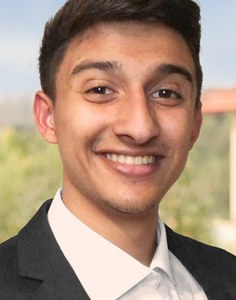 Portrait: Knight-Hennessy Scholars, Stanford University
Pranav Lalgudi studied biology at MIT, where he worked on how cells adjust their metabolism to the nutrients they receive, a process that goes wrong in cancer and diabetes. His work was in David Sabatini's group at the Whitehead Institute, and he is third author of the 2022 and 2025 Nature papers on the structure of GATOR2.
He then joined the genetics PhD program at Stanford as a Knight-Hennessy Scholar. Before the PhD he also worked at Stanford on new tools for studying the genetic diversity of cancers.
The timeline below traces his studies gathered in this Atlas.
Milestones in the Atlas
A selection, not a full bibliography: only papers that meet the Atlas inclusion criteria.
| Year | Evidence | Study |
|---|---|---|
| 2022 | M | Structure of the nutrient-sensing hub GATOR2 VAL2022 Co-author: cryo-EM structure of GATOR2. |
| 2025 | M | Structural basis for the dynamic regulation of mTORC1 by amino acids VAL2025 Co-author: structures of GATOR2 bound to Sestrin2 or CASTOR1. |
Co-authors in the Atlas
People with a profile here who share at least one study with Pranav V. Lalgudi.
- Max L. Valenstein 2 shared studies First author of the cryo-EM structures of GATOR2, the hub that tells mTORC1 whether amino acids are present, alone and bound to the sensors Sestrin2 and CASTOR1
- David M. Sabatini Identified mTOR (as RAFT1) in 1994. His lab then mapped much of the machinery around it: raptor and rictor at the core of mTORC1 and mTORC2, the Rag–Ragulator system that docks mTORC1 on the lysosome, and the sensors that detect leucine, arginine and SAM
- Kacper B. Rogala Solved the near-atomic cryo-EM structure that shows how mTORC1 physically docks at the lysosome by reading the Rag GTPases
- Lynne Chantranupong Showed as a Sabatini-lab graduate student that the Sestrins act through GATOR2 to regulate amino-acid signalling to mTORC1. She then discovered the CASTOR proteins, the cell's arginine sensors for the pathway
- Robert A. Saxton Solved, as a Sabatini-lab graduate student, the structures of the leucine sensor Sestrin2 and the arginine sensor CASTOR1, showing how each one grips its amino acid. He also co-wrote a widely cited 2017 review of mTOR signalling with David Sabatini
Every researcher with a profile →
Thank you. Your answer was counted anonymously.
Thank you. That helps us know which pages have been read by someone who knows the work.
Thank you. We will check it and correct the page.