Dirk Hockemeyer
Stem-cell biologist whose laboratory builds engineered human stem-cell and mouse models of disease, using genome editing and functional genomics screens.
Professor of Cell Biology, Development and Physiology, Molecular and Cell Biology, UC Berkeley (promoted 2025)
Hockemeyer Lab, Department of Molecular and Cell Biology, University of California, Berkeley (Berkeley, California, USA) ↗ ORCID0000-0002-5598-5092 ↗
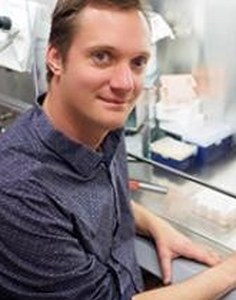 Portrait: UC Berkeley, Hockemeyer Lab
Dirk Hockemeyer runs a laboratory at UC Berkeley that makes human disease models from stem cells. The group edits the genome of human pluripotent stem cells, which can become almost any cell type, and then uses those cells, along with mouse models and genome-wide screens, to study what a given mutation actually does.
That approach is the backbone of the 2026 Nature study in the Atlas, done with Helen Bateup's laboratory. Brain organoids (small, lab-grown clusters of human brain cells) carrying loss-of-function mutations in TSC2, the gene mutated in tuberous sclerosis, together with tissue from patients, showed that overactive mTORC1 pushes neural progenitor cells to become reactive astrocytes. The effect arises inside the cells themselves rather than from outside signals.
For a reader of the Atlas the paper is a useful reminder that mTORC1 hyperactivity in tuberous sclerosis is not only a neuron story. It also changes which glial cells the developing brain produces.
Milestones in the Atlas
A selection, not a full bibliography: only papers that meet the Atlas inclusion criteria.
| Year | Evidence | Study |
|---|---|---|
| 2026 | M | mTORC1 drives cell-autonomous astrocyte reactivity in tuberous sclerosis LI2026C Senior author with Helen Bateup; stem-cell engineered TSC2-mutant brain organoids showed that hyperactive mTORC1 drives cell-autonomous astrocyte reactivity. |
Co-authors in the Atlas 2
People with a profile here who share at least one study with Dirk Hockemeyer.
ShowHide
- Helen S. Bateup Senior/corresponding author of a 2026 Nature study showing mTORC1 hyperactivity drives cell-autonomous astrocyte reactivity in tuberous sclerosis
- Thomas L. Li Co-first author of a 2026 Nature study showing mTORC1 hyperactivity drives reactive astrocytes as a primary, seizure-independent consequence of TSC2 loss, implicating glial dysfunction as a driver of tuberous sclerosis pathology
Every researcher with a profile →
Thank you. That helps us know which pages have been read by someone who knows the work.
Thank you. We will check it and correct the page.
Thank you. Your answer was counted anonymously.