Christopher Johnson
Biophysicist who built and ran the Biophysics Facility at the MRC Laboratory of Molecular Biology, measuring how proteins fold, bind and change shape for dozens of research groups
Head of the Biophysics Facility, MRC Laboratory of Molecular Biology, Cambridge (2009–2022, semi-retired since) · MRC Centre for Protein Engineering, Cambridge (from 1992) · postdoc, University of Glasgow · PhD in protein folding, Department of Biochemistry at a Scottish university
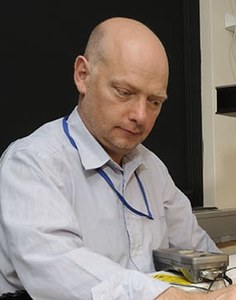 Portrait: MRC Laboratory of Molecular Biology
Christopher Johnson is a co-author of two structural papers in the Atlas from Roger Williams' group at the MRC Laboratory of Molecular Biology in Cambridge. BAR2016 used cryo-electron microscopy to show that the Tor kinase, bound to its partner Lst8, pairs up into a dimer through a long coiled stretch of helices at its front end. ANA2019 solved structures of the human Rag GTPases, the switch proteins that bring mTORC1 to the lysosome when amino acids are present, and showed how they bind mTORC1. Pictures from microscopes and crystals are usually checked with solution measurements, for example of how tightly two proteins bind or whether a complex stays together in liquid, and that is the kind of work a biophysics facility provides.
Johnson studied biology, then did a PhD on protein folding in a biochemistry department in Scotland and a postdoc at the University of Glasgow on protein thermodynamics and calorimetry, the measurement of the heat released or absorbed when molecules bind. From 1992 he worked at the MRC Centre for Protein Engineering in Cambridge. When that centre closed he joined the LMB in 2009 as head of its new Biophysics Facility, which came to serve more than 50 research groups with calorimetry, spectroscopy and kinetic methods. He also built and adapted instruments with the LMB workshop.
In 2022 Stephen McLaughlin became head of the facility, and the LMB described Johnson as semi-retired and still supporting the team part-time with training.
Milestones in the Atlas
A selection, not a full bibliography: only papers that meet the Atlas inclusion criteria.
| Year | Evidence | Study |
|---|---|---|
| 2016 | M | Tor forms a dimer through an N-terminal helical solenoid with a complex topology BAR2016 Co-author of the cryo-EM study showing that Tor forms a dimer through a long helical region at its N-terminus. |
| 2019 | M | Architecture of human Rag GTPase heterodimers and their complex with mTORC1 ANA2019 Co-author of the structural study of the human Rag GTPases and their complex with mTORC1. |
Co-authors in the Atlas 6
People with a profile here who share at least one study with Christopher Johnson.
ShowHide
- Alex Berndt 2 shared studies Protein scientist in Roger Williams' group at the MRC Laboratory of Molecular Biology who helped solve structures of PI3K enzymes and of mTOR and its partners
- Roger L. Williams 2 shared studies Solved structures showing how the Rag GTPases bind mTORC1 and how TOR forms a dimer, working at the MRC Laboratory of Molecular Biology
- David M. Sabatini Identified mTOR (as RAFT1) in 1994. His lab then mapped much of the machinery around it: raptor and rictor at the core of mTORC1 and mTORC2, the Rag–Ragulator system that docks mTORC1 on the lysosome, and the sensors that detect leucine, arginine and SAM
- Domagoj Baretić Structural biologist who, while at the MRC Laboratory of Molecular Biology, solved early cryo-EM structures of Tor and its relatives, and now works on ADP-ribosylation enzymes at Oxford
- Kacper B. Rogala Solved the near-atomic cryo-EM structure that shows how mTORC1 physically docks at the lysosome by reading the Rag GTPases
- Madhanagopal Anandapadamanaban Structural biologist at the MRC Laboratory of Molecular Biology who solved the structure of the human Rag GTPases bound to mTORC1, showing how amino acids bring mTORC1 to the lysosome
Every researcher with a profile →
Thank you. That helps us know which pages have been read by someone who knows the work.
Thank you. We will check it and correct the page.
Thank you. Your answer was counted anonymously.