Ana Maria Cuervo
Worked out much of the machinery of chaperone-mediated autophagy, a pathway first described in Fred Dice's laboratory, and showed it declines with age
Distinguished Professor, Department of Developmental and Molecular Biology and Department of Medicine (Hepatology) · Robert and Renée Belfer Chair for the Study of Neurodegenerative Diseases · Co-Director, Institute for Geroscience, Albert Einstein College of Medicine · own laboratory at Einstein since October 2001
Cuervo Lab, Institute for Geroscience, Albert Einstein College of Medicine (Bronx, New York, USA) ↗ ORCID0000-0002-0771-700X ↗
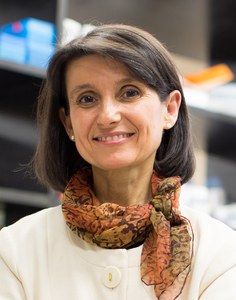 Portrait: Albert Einstein College of Medicine
Most of what is said about autophagy in the ageing literature is about macroautophagy: the membrane wraps a piece of cytoplasm and delivers it to the lysosome. Cuervo's laboratory built the case that a second, selective route matters too. In chaperone-mediated autophagy the substrate is recognised by a targeting motif, carried by a chaperone, unfolded at the lysosomal membrane and pulled through a LAMP2A translocation complex one molecule at a time.
Two of her findings shape how the Atlas should read this branch. CMA activity falls with age, and restoring it in old animals improves proteostasis — which makes it a candidate mechanism for age-related decline rather than a curiosity. And in ARI2015 her group showed the pathway is under mTOR control, but through mTORC2 and lysosomal Akt, not through the mTORC1–ULK1 step that governs macroautophagy.
That difference is the useful part. The Atlas states that mTOR inhibits autophagy; ARI2015 shows the statement is complex-specific, and that a different mTOR complex regulates a different kind of autophagy by a different mechanism.
Milestones in the Atlas
| Year | Evidence | Study |
|---|---|---|
| 2015 | M | Lysosomal mTORC2/PHLPP1/Akt regulate chaperone-mediated autophagy ARI2015 Senior author: mTORC2 inhibits chaperone-mediated autophagy at the lysosomal membrane via Akt, with PHLPP1 counteracting it. |
Co-authors in the Atlas
People with a profile here who share at least one study with Ana Maria Cuervo.
- Esperanza Arias-Perez Showed that mTORC2, working with PHLPP1 and Akt at the lysosome, regulates chaperone-mediated autophagy
Every researcher with a profile →
On the programme
Meetings in the Atlas calendar where Ana Maria Cuervo is listed among the speakers or organisers.
- upcoming Keystone Symposia: Autophagy in Health and Disease – From Mechanisms to Therapeutics 2027 ↗ 8–11 Feb 2027 · Banff, AB, Canada · ★★
- upcoming SEFAGIA Meeting 2027 ↗ 3–5 Feb 2027 · Alfara del Patriarca (Valencia), Spain · ★★
- upcoming Cell Symposia: Hallmarks of Aging 2026 ↗ 4–6 Oct 2026 · Seville, Spain · ★★
- past CSHL: Protein Homeostasis in Health and Disease 2026 (17th) ↗ 21–25 Apr 2026 · Cold Spring Harbor, NY, USA · ★