Yoshiaki Kamada
Showed as first author that TOR keeps autophagy switched off in yeast by controlling the Atg1 (Apg1) kinase complex, and has studied TOR's control of autophagy ever since
Assistant Professor, National Institute for Basic Biology, National Institutes of Natural Sciences, Okazaki, Japan · ORCID 0000-0001-7395-660X
National Institute for Basic Biology, Okazaki (Okazaki, Japan) ↗ ORCID0000-0001-7395-660X ↗
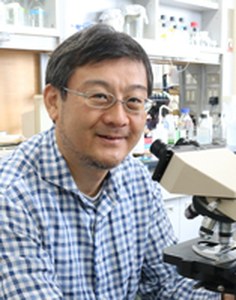 Portrait: National Institute for Basic Biology
In 2000, in Yoshinori Ohsumi's group, Kamada asked a question that sounds simple and was not: how does TOR actually stop a cell from digesting itself? The answer turned out to be a phosphorylation switch one step upstream of the autophagy machinery. Starving the cells, or treating them with rapamycin, raised the kinase activity of Apg1 (now Atg1, the yeast counterpart of mammalian ULK1). TOR was keeping Apg13 hyperphosphorylated, and phosphorylated Apg13 binds Apg1 poorly. Remove TOR signalling and Apg13 loses its phosphates, binds Apg1, and autophagy starts.
The same paper drew a line that is easy to miss: the Apg1–Apg13 association is needed for autophagy but not for the Cvt pathway, a related vesicle route that uses many of the same proteins during normal growth. That made the Apg1 complex a switch between two transport systems rather than a simple on/off for one, which is why the finding survived the move from yeast to mammals.
His group at NIBB still works on TORC1 in budding yeast, and the NIBB page lists the same three threads: how amino acids regulate TORC1, how TORC1 controls autophagy through Atg13 phosphorylation, and how TORC1 acts on eIF4E-binding proteins. The mammalian version of his 2000 result (ULK1–ATG13–FIP200) was published nine years later.
Milestones in the Atlas
| Year | Evidence | Study |
|---|---|---|
| 2000 | M | Tor-mediated induction of autophagy via an Apg1 protein kinase complex KAM2000 First author: TOR represses autophagy by keeping Apg13 hyperphosphorylated, so it cannot bind and activate the Apg1 kinase. |
Co-authors in the Atlas
People with a profile here who share at least one study with Yoshiaki Kamada.
- Yoshinori Ohsumi Found the genes that make autophagy work, and with them the link from TOR to the autophagy machinery